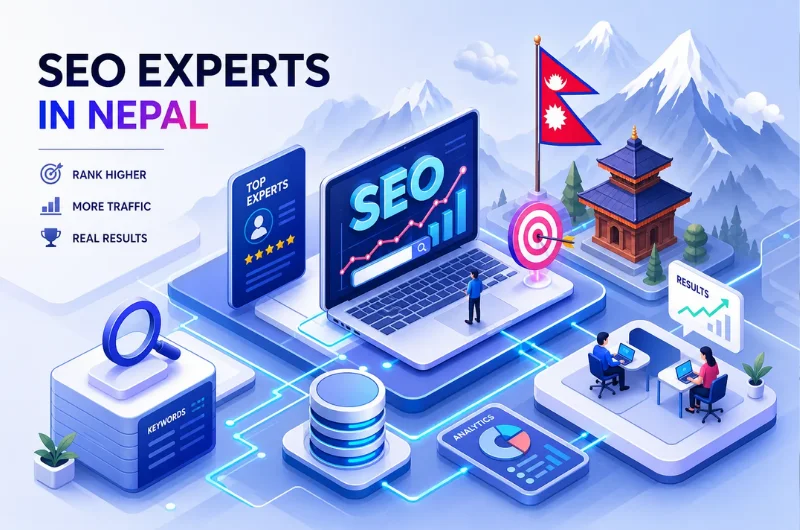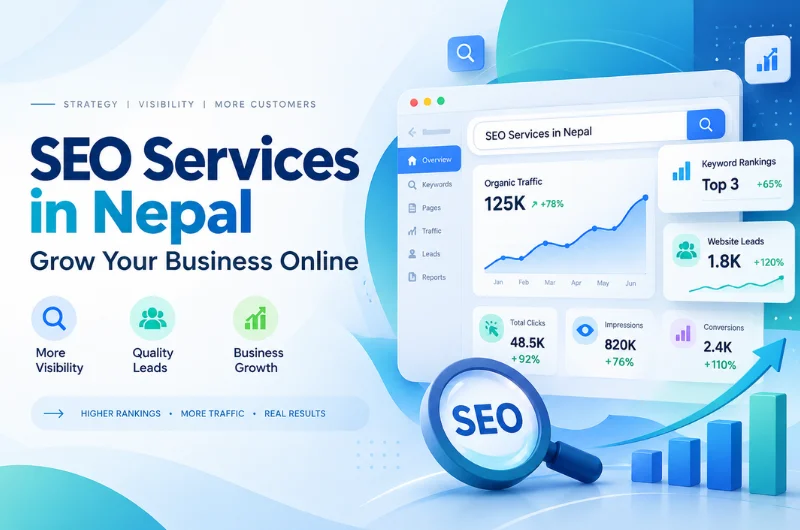
SEO Services in Nepal to Grow Your Business Online

In today’s competitive digital landscape, having a website is only the first step toward building a successful online business. If potential customers cannot find your website on Google, you could be missing valuable opportunities to attract visitors, generate leads, and increase sales.

This is where professional SEO services in Nepal can make a difference.

Search Engine Optimization (SEO) helps businesses improve their website’s visibility in search engine results, reach potential customers, and establish a stronger online presence.

Whether you own a small business, e-commerce store, travel agency, educational institution, or corporate company, investing in the right SEO strategy can support your long-term digital growth.

In this article, we’ll explore how SEO works, the different types of SEO services available in Nepal, their benefits, and how to choose the right SEO company for your business.

What Is SEO and Why Is It Important for Businesses in Nepal?

Search Engine Optimization (SEO) is the process of improving a website’s content, structure, technical performance, and online reputation to increase its visibility in organic search results.

For example, when someone searches Google for “best trekking agency in Nepal,” “web design company in Kathmandu,” or “restaurants in Pokhara,” search engines display websites and business listings that appear relevant to those queries.

With an effective SEO strategy, your business has a better opportunity to appear when potential customers search for the products or services you offer.

According to DataReportal’s Digital 2026: Nepal report, approximately 16.6 million people were using the internet in Nepal in late 2025. This highlights the importance of creating a strong digital presence for businesses targeting online customers.

SEO helps your website become more discoverable while building credibility and creating opportunities for organic traffic.

Unlike paid advertising, which requires ongoing spending to maintain ad placements, SEO focuses on developing sustainable visibility through helpful content, technical improvements, and website optimization.

However, achieving meaningful results requires a consistent strategy and continuous improvement.

Why Your Business Needs Professional SEO Services in Nepal

Businesses across Nepal are increasingly investing in websites, e-commerce platforms, and digital marketing.

Simply launching a website does not guarantee that customers will find it.

Professional SEO services help bridge the gap between your business and people actively searching for your offerings.

1. Improve Your Website’s Google Visibility

One of the primary goals of SEO is to help your website appear for relevant searches on Google.

By optimizing website content, headings, page titles, and technical elements, you make it easier for search engines to understand your website.

Improved visibility creates more opportunities for customers to discover your business.

2. Attract Relevant Organic Traffic

SEO focuses on attracting visitors who are already interested in your products or services.

For example, a construction company targeting “house construction services in Kathmandu” can use SEO to reach people searching for those services.

This targeted approach can bring more relevant traffic than broad marketing campaigns.

3. Generate Quality Leads and Inquiries

A successful SEO strategy is not just about increasing website visits. It is about encouraging visitors to take meaningful actions.

These actions may include submitting contact forms, calling your business, requesting quotations, making bookings, or purchasing products.

Optimizing both search visibility and the website experience can help improve lead generation.

4. Build Brand Credibility and Trust

A professional website with informative content, transparent business information, and a positive user experience can strengthen customer confidence.

When your website consistently provides useful answers to customers’ questions, it can become a trusted source of information in your industry.

5. Support Long-Term Business Growth

SEO is a long-term marketing investment.

Unlike advertising campaigns that stop generating paid clicks when the budget ends, well-maintained SEO improvements can continue creating opportunities over time.

Although rankings and traffic can fluctuate, an effective SEO strategy can provide lasting business value.

Types of SEO Services Available in Nepal

Professional SEO companies offer different services depending on the needs, objectives, and size of a business.

Understanding these services will help you choose the right strategy.

1. Keyword Research and SEO Strategy

Keyword research is the foundation of an effective SEO campaign.

It involves identifying the words and phrases your potential customers use when searching online.

An SEO specialist evaluates search intent, relevance, competition, and potential business value before selecting appropriate keywords.

Examples of location-based keywords include:

  • SEO services in Nepal
  • Website development company in Kathmandu
  • Digital marketing agency in Nepal
  • Best hotels in Pokhara
  • Online shopping in Nepal

A strong keyword strategy focuses not only on search volume but also on how closely the search terms align with your business offerings.

2. On-Page SEO Optimization

On-page SEO focuses on improving individual website pages to make them more useful for visitors and understandable to search engines.

Important activities include optimizing page titles, meta descriptions, headings, website URLs, images, content structure, and internal links.

For example, a page offering digital marketing services should clearly explain those services while naturally incorporating relevant search terms.

High-quality on-page optimization improves content organization, relevance, and user experience.

3. Technical SEO Services

Technical SEO focuses on the underlying elements that help search engines discover, crawl, and index your website.

Common technical SEO activities include:

  • Improving website loading speed
  • Ensuring mobile responsiveness
  • Fixing broken links and redirect issues
  • Creating and maintaining XML sitemaps
  • Reviewing robots.txt and indexing settings
  • Implementing appropriate canonical URLs
  • Improving Core Web Vitals
  • Adding relevant structured data

A technically well-optimized website provides a stronger foundation for successful SEO campaigns.

4. Local SEO Services in Nepal

Local SEO is especially important for businesses targeting customers in specific cities or geographic areas.

For example, businesses operating in Kathmandu, Lalitpur, Bhaktapur, Pokhara, Butwal, or Chitwan can benefit from location-focused optimization.

Local SEO services typically include Google Business Profile optimization, local keyword research, accurate business information, customer review management, and location-specific landing pages.

If someone searches for “SEO company in Kathmandu” or “restaurants near me,” local optimization can help relevant businesses become more discoverable in Google Search and Maps.

An optimized Google Business Profile can also make it easier for customers to access your address, contact information, business hours, and directions.

5. Content Marketing and SEO Content Writing

Content is an essential part of a successful SEO strategy.

Publishing informative, original, and relevant content helps answer customer questions and attract visitors searching for specific information.

SEO content services may include blog writing, service page optimization, product descriptions, landing page content, FAQ development, and existing content improvements.

For example, a website development company in Nepal could publish blogs about website design costs, WordPress development, e-commerce solutions, and SEO strategies.

These articles can help attract potential customers who are researching digital services.

The most effective content is written primarily to help readers rather than simply repeating keywords.

6. Off-Page SEO and Link Building

Off-page SEO involves activities outside your website that can improve its reputation and online visibility.

A common component is earning relevant backlinks from trustworthy websites.

Other activities may include digital public relations, industry partnerships, relevant business listings, and brand mentions.

Quality is more important than quantity when building backlinks.

Businesses should avoid purchasing spammy links or participating in manipulative link schemes, as these practices can negatively affect search performance.

7. E-commerce SEO Services

E-commerce SEO helps online stores improve product and category page visibility in search engines.

This service is particularly useful for businesses selling clothing, electronics, beauty products, furniture, and other goods online.

E-commerce SEO activities include product keyword research, category page optimization, product descriptions, internal linking, image optimization, and technical improvements.

An effective strategy also addresses duplicate content, product availability, navigation, and the user experience.

With proper optimization, online stores can attract customers looking for specific products and increase opportunities for sales.

How SEO Services Help Different Businesses in Nepal

Different industries require different SEO approaches.

Business Industry SEO Opportunities
Travel and Tourism Attract travelers searching for trekking, tours, and travel packages
Hotels and Restaurants Improve local search visibility and booking inquiries
Educational Institutions Reach students searching for colleges, courses, and admissions
Healthcare Providers Improve visibility for relevant local healthcare searches
E-commerce Businesses Increase product discovery and online sales opportunities
Real Estate Companies Reach property buyers and renters
Professional Services Generate relevant inquiries for legal, financial, consulting, and IT services

For example, a trekking company may focus on international search queries, while a restaurant in Kathmandu may prioritize local SEO and Google Maps visibility.

An experienced SEO agency should tailor its strategy to your target audience and business objectives.

Our Recommended SEO Process for Business Growth

A successful SEO campaign requires research, planning, implementation, and ongoing monitoring.

Step 1: Website SEO Audit

The process begins with a comprehensive review of the website to identify technical issues, content gaps, indexing problems, and potential optimization opportunities.

Step 2: Competitor Analysis and Keyword Research

SEO specialists analyze competitors and identify keywords that align with your business objectives.

This helps establish an effective strategy based on search intent and competition.

Step 3: On-Page and Technical Optimization

Website pages are optimized for relevant search terms, while technical issues affecting crawling, indexing, and user experience are addressed.

Step 4: Content Development

Informative service pages, articles, landing pages, and other resources are created or improved to answer customer questions and support search visibility.

Step 5: Local SEO and Authority Building

Where appropriate, the strategy includes Google Business Profile optimization, reputable business citations, relevant partnerships, and opportunities to earn quality backlinks.

Step 6: Performance Tracking and Continuous Improvement

SEO performance is monitored using tools such as Google Search Console and Google Analytics.

Reports may include organic traffic, search impressions, keyword visibility, inquiries, conversions, and completed optimization activities.

The strategy is then refined based on results and changing business priorities.

How Long Does SEO Take to Show Results in Nepal?

One of the most common questions businesses ask is how quickly SEO can deliver results.

SEO does not usually produce immediate outcomes.

Some technical fixes and content improvements may become noticeable relatively quickly, but meaningful organic growth often requires several months of consistent work.

As a general planning guideline, businesses may evaluate early progress over three to six months, while competitive industries may need six to twelve months or longer.

These are approximate timelines, not guarantees.

Actual results depend on website history, industry competition, keyword difficulty, content quality, technical condition, and the consistency of optimization efforts.

A reputable SEO company should set realistic expectations rather than promise instant first-page rankings.

How Much Do SEO Services Cost in Nepal?

SEO service costs in Nepal vary depending on the size of your website, industry competition, target keywords, required activities, and campaign objectives.

A small local business targeting a few service-related keywords may require a simpler SEO package than an e-commerce company with hundreds of products.

Common pricing arrangements include monthly SEO retainers, one-time website audits, project-based optimization, and customized campaigns.

Before choosing a package, ask your SEO provider to explain the scope of work, monthly deliverables, content requirements, reporting methods, and any additional costs.

Rather than choosing the cheapest SEO package, focus on the quality of services, transparency, and whether the proposed strategy addresses your business goals.

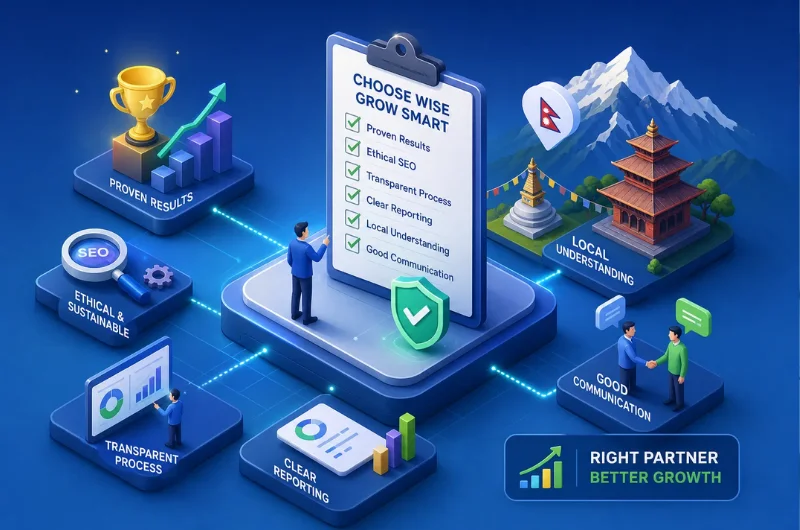
How to Choose the Best SEO Company in Nepal

Choosing the right SEO partner can make a significant difference in your digital marketing results.

Before hiring an SEO agency, consider the following factors.

Experience and expertise: Review the company’s experience with SEO, technical optimization, content marketing, and businesses similar to yours.

Portfolio and case studies: Ask for examples of past projects and measurable results. Reliable case studies should explain what was achieved and over what period.

Customized SEO strategy: Avoid one-size-fits-all solutions. Your SEO campaign should reflect your industry, target customers, website condition, and business objectives.

Transparent reporting: A professional SEO agency should provide regular updates explaining completed activities and performance changes.

Ethical SEO techniques: Choose a company that follows search engine guidelines and avoids spammy backlinks, keyword stuffing, and manipulative practices.

Communication and support: Select a provider that explains its recommendations clearly and works collaboratively with your team.

Most importantly, avoid agencies promising guaranteed number-one Google rankings. Search engine positions cannot be guaranteed by an SEO provider.

Common SEO Mistakes Businesses Should Avoid

Businesses sometimes invest in SEO without achieving their expected results because of avoidable mistakes.

These include targeting irrelevant keywords, publishing low-quality content, neglecting mobile users, and ignoring technical website issues.

Other common mistakes include duplicating content across pages, creating too many similar location pages, buying low-quality backlinks, and failing to monitor performance.

SEO should also not focus exclusively on traffic numbers.

Attracting thousands of visitors who have no interest in your products or services may provide little business value.

A better approach is to target relevant searches and improve the experience that visitors have after reaching your website.

Frequently Asked Questions About SEO Services in Nepal

What are SEO services?

SEO services involve improving a website’s search engine visibility through keyword research, content optimization, technical improvements, local SEO, and other relevant activities.

Why is SEO important for small businesses in Nepal?

SEO helps small businesses reach potential customers who are actively searching for their products or services. It can improve online visibility, support lead generation, and reduce reliance on paid advertising over time.

How much does SEO cost in Nepal?

SEO pricing varies based on website size, competition, target locations, and the services included. Businesses should request a customized quotation based on their goals and requirements.

Can SEO help my business appear on Google Maps?

Yes. Local SEO and Google Business Profile optimization can improve the information Google uses to understand and display relevant businesses in local search results. Placement depends on factors such as relevance, distance, and prominence.

Is SEO better than Google Ads?

SEO and Google Ads serve different purposes. Google Ads can generate paid visibility quickly, while SEO focuses on improving organic search visibility over time. Many businesses benefit from combining both strategies.

Do I need SEO if I already have a website?

Yes, if attracting customers through organic search is part of your business strategy. A website can be visually attractive but still have technical, content, or visibility issues that prevent potential customers from finding it.

Can SEO guarantee first-page Google rankings?

No. No legitimate SEO agency can guarantee specific organic rankings. Search performance depends on numerous factors, including competition, website quality, relevance, and search engine systems.

Conclusion: Grow Your Business Online with Professional SEO Services in Nepal

In an increasingly digital marketplace, search engine optimization plays an important role in helping businesses improve online visibility and connect with potential customers.

From keyword research and technical SEO to local optimization, content marketing, and performance monitoring, a well-planned SEO strategy can strengthen your digital presence.

Whether you operate a small local business, professional service company, online store, or established organization, professional SEO services in Nepal can help you attract relevant website traffic and create more opportunities for business growth.

However, successful SEO requires patience, consistent effort, and an understanding of your customers’ needs.

By partnering with an experienced SEO company and investing in ethical, data-driven optimization, you can build a stronger foundation for long-term online success.

Ready to Grow Your Business with SEO?

Want to improve your website’s Google visibility, attract potential customers, and generate more business inquiries?

Contact our team for professional SEO services in Nepal. We can help you evaluate your current website, identify growth opportunities, and develop an SEO strategy tailored to your business goals.

Start building a stronger online presence today.
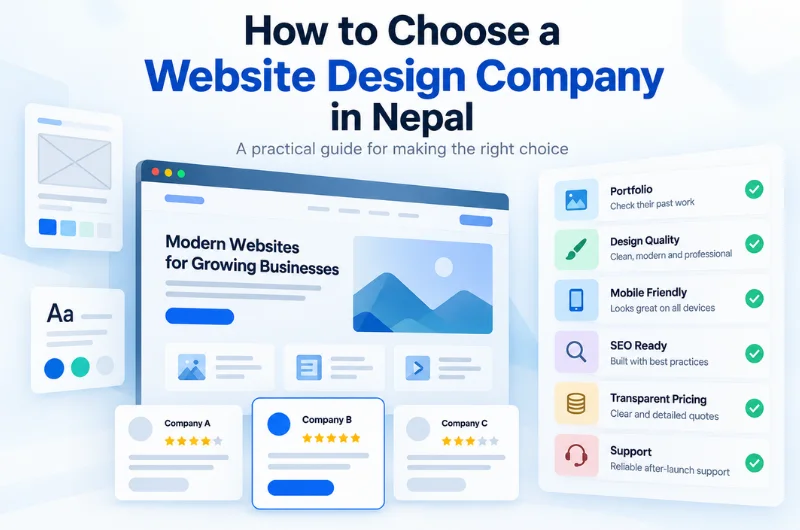
How to Choose a Website Design Company in Nepal

Planning to build a website for your business? One of the first things you’ll need to decide is who should design and develop it.

There are plenty of website design companies in Nepal, and most of them promise attractive designs, affordable prices, and quality service. But how do you know which company is actually right for your business?

A website is something you’ll use for years. It represents your business, helps customers learn about your services, and gives people a way to contact you. If it’s poorly designed or difficult to use, potential customers might leave before even finding out what you offer.

That’s why choosing the right website design company matters.

In this article, we’ll walk you through the things you should look for before hiring a website design company in Nepal. We’ll also share some useful tips to help you avoid common mistakes and get a website that works for your business.

1. Know What You Want From Your Website

Before you start searching for a website design company, think about what you actually need.

Are you looking for a simple website to introduce your company? Do you want to sell products online? Or do you need a website where customers can make bookings, submit inquiries, or access specific services?

For example, a restaurant in Kathmandu might need a website with its menu, location, photos, and reservation details. An online clothing store will need product pages, shopping carts, payment options, and order management.

Both businesses need a website, but their requirements are completely different.

You don’t need to understand all the technical details. Just having a clear idea of what you want your website to do will make conversations with developers much easier.

It also helps the website design company suggest the right solution instead of selling you features you might never use.

2. Take a Good Look at Their Previous Work

One of the easiest ways to understand a company’s capabilities is to check the websites they have already built.

Most website design companies have a portfolio section where you can explore their completed projects.

Don’t just look at the screenshots. Open a few websites and actually use them.

See how quickly they load, how easy the menus are to navigate, and whether the design looks good on your phone.

A website might look impressive in a portfolio image but feel completely different when you’re browsing it.

You should also look for variety in their work. Have they developed websites for different types of businesses? Can they create something that suits your brand rather than using the same layout for every client?

For instance, Webtech Nepal has worked on website projects for different businesses and organizations. You can explore its portfolio to get an idea of the types of websites it develops.

Taking a little time to review previous projects can tell you much more than a company’s sales pitch.

3. Make Sure They Understand Good Website Design

A good website isn’t just about beautiful colors, images, and animations.

It should also be easy for people to use.

Imagine visiting a website to find a company’s phone number. You click through several pages, open different menus, and still can’t find the contact details.

Frustrating, right?

Your customers shouldn’t have that experience.

A good website design company understands how people browse websites. It knows where to place important information, how to organize content, and how to make navigation simple.

The design should also match your business.

A corporate website might need a clean and professional appearance, while a creative agency could benefit from a more expressive design.

When discussing your project, ask the company how it plans to organize your website and what design approach it recommends.

A good designer should be able to explain these decisions in simple language.

4. Your Website Must Work Well on Mobile Phones

Many customers will visit your website from their phones, so mobile design deserves just as much attention as desktop design.

Your website should look good and work properly on smartphones, tablets, and computers.

Visitors shouldn’t have to zoom in to read text, struggle to click buttons, or scroll sideways to view content.

This is called responsive website design.

Before choosing a company, open some of its previous projects on your phone. Try using the navigation menu, submitting a contact form, and reading the content.

If those websites are difficult to use on mobile devices, that’s something worth discussing with the company.

At Webtech Nepal, responsive website design is one of the services offered to help businesses make their websites accessible across different screen sizes.

5. Ask Whether the Website Will Be SEO Friendly

A website can have a great design, but what happens if people can’t find it on Google?

That’s where Search Engine Optimization, commonly known as SEO, comes in.

SEO helps search engines understand your website and can improve its chances of appearing when customers search for relevant products or services.

For example, someone looking for a hotel in Pokhara might search Google for hotels in that area. A hotel website with useful content, properly organized pages, and good technical SEO has a better foundation for being discovered.

When hiring a website design company in Nepal, ask whether basic SEO is included in the development process.

This may involve properly structured pages, optimized images, suitable page titles, clear URLs, and good loading performance.

Keep in mind that building an SEO friendly website is different from providing ongoing SEO services.

If you want your company to compete for specific Google searches, you’ll probably need additional SEO work after the website is launched.

Webtech Nepal offers website development alongside SEO services, which can be useful for businesses planning their website and marketing activities together.

6. Understand What You’re Paying For

Website design prices in Nepal can vary quite a bit.

You might receive one quotation for Rs. 25,000 and another for Rs. 100,000 for what initially sounds like the same project.

That doesn’t necessarily mean one company is overcharging.

The difference could come from the design process, number of pages, technology, features, content management system, or support included.

For example, a basic website built using an existing template will generally cost less than a custom website designed specifically for your business.

Before making a decision, ask for a detailed quotation.

Find out whether domain registration, hosting, SSL certificates, content uploads, design revisions, and basic SEO are included.

Also ask if there will be any additional charges after the website is completed.

A clear quotation helps you understand exactly what you’re buying and makes it easier to compare different companies.

Don’t choose a website design company only because it offers the lowest price. A cheap website may become expensive if you need to rebuild it or repeatedly pay someone to fix problems.

7. Find Out Which Technology They Recommend

You might hear developers talking about WordPress, Laravel, React, or other website technologies.

If you’re not familiar with these terms, that’s completely fine.

What’s important is understanding why the company recommends a particular technology for your project.

For many business websites, WordPress can be a practical choice. It allows you to update pages, add blog posts, and manage content without having to change the website’s code.

For more complex projects, such as booking systems, customer portals, or business applications, custom development may be more suitable.

A good website development company should recommend technology based on what your business needs.

It should also explain how easily your website can be updated or expanded later.

If you plan to add an online store, additional services, or new functionality in the future, discuss those plans before development begins.

8. Don’t Forget About Website Maintenance

A website doesn’t stop needing attention once it’s published.

Over time, you may need to update information, add new services, fix technical problems, or improve security.

This is why it’s important to ask about maintenance and support before choosing a developer.

Some companies include a limited support period in their website packages. Others offer separate monthly or annual maintenance plans.

Ask what happens if your website stops working or if you need help updating something.

Will someone be available to assist you? How is technical support handled? Are backups and updates included?

These are simple questions, but the answers can make a big difference later.

Working with a company that provides ongoing support can be particularly helpful if you don’t have an in house technical team.

Webtech Nepal also offers website maintenance and technical support services, so businesses can discuss their needs beyond the initial development project.

9. Communication Makes a Big Difference

You don’t have to be a technical person to get a good website built.

But you do need a development team that listens to you.

Pay attention to how the company communicates during your first few conversations.

Do they take time to understand your business? Do they ask useful questions? Are they willing to explain things when you don’t understand something?

Or do they immediately start talking about packages and prices?

Good communication makes the entire process easier.

You should feel comfortable sharing your ideas, asking for changes, and discussing concerns.

It also helps to know who you’ll be communicating with during development and how often you’ll receive progress updates.

A company that’s easy to work with can save you a lot of unnecessary stress.

10. Check Reviews and Client Feedback

Before hiring a website design company, spend a little time checking what previous clients have said about it.

You can look for reviews on Google, testimonials on the company’s website, or feedback from businesses that have worked with the team.

Pay attention to comments about communication, project delivery, technical support, and overall satisfaction.

If possible, speak with a previous client.

Ask whether the company delivered what was promised and how it handled problems during development.

Of course, no company will have a perfect experience with every client.

What matters is whether it communicates professionally and takes responsibility when issues arise.

Client feedback, combined with portfolio quality and your own discussions with the company, can help you make a more informed decision.

11. Make Sure You Have Access to Your Website

This is something many business owners forget to discuss.

After the website is completed, will you have access to the hosting account, domain registration, and website administration panel?

Can you update your own content?

What happens if you decide to work with a different developer in the future?

These details should be clear before the project starts.

Ideally, your company should control its domain name and have the necessary access to manage the website.

For custom development projects, you should also discuss ownership of the code, design files, and other project materials.

Having everything documented helps avoid misunderstandings later.

A professional website design company should be transparent about these arrangements.

12. Think About Your Business’s Future

Your business might be small today, but your website should leave room for growth.

Maybe you’re starting with a simple company website and plan to sell products online later.

Or perhaps you want to add online bookings, customer accounts, or additional languages as your business expands.

Talk about these plans with the development company.

It doesn’t mean you need to pay for every feature right now. The idea is to choose a solution that won’t become a problem when your requirements change.

The right development partner can help you decide what to build now and what can be added later.

Why Consider Webtech Nepal for Your Website?

If you’re looking for a website design company in Nepal, Webtech Nepal is one of the options worth exploring.

Based in Kathmandu, Webtech Nepal provides website design and development services for businesses and organizations with different requirements.

Its services include business website design, WordPress development, e-commerce websites, custom web development, SEO, and website maintenance.

This means businesses can discuss different aspects of their website project with the same team, from the initial design to ongoing technical support.

For example, if you need a company website today but want to add new features or improve your Google visibility later, you can discuss those requirements during the planning stage.

You can visit the Webtech Nepal website to learn more about its services and view previous projects.

As with any development company, it’s worth discussing your requirements, reviewing its work, and requesting a detailed proposal before making your decision.

A Few Questions Worth Asking Before You Hire

Once you’ve shortlisted a few website design companies, arrange a conversation with each of them.

You don’t need a long list of technical questions. Start with these:

  1. Have you developed websites similar to mine?
  2. Can I see some of your recent projects?
  3. What exactly is included in your quotation?
  4. Will I be able to update the website myself?
  5. How long will the project take?
  6. What support will I receive after launch?
  7. Will I have access to my domain, hosting, and website?

A company should be able to answer these questions clearly.

If the answers are confusing or important details are missing, ask for clarification before committing to the project.

Frequently Asked Questions

How do I find a good website design company in Nepal?

Start by checking company portfolios, reading client reviews, and comparing the services offered. Speak with a few companies to understand their development process, pricing, and support. Choose the one that understands your requirements and communicates clearly.

How much does a business website cost in Nepal?

The price depends on the design, number of pages, functionality, and technology used. Simple business websites are generally more affordable, while custom websites and e-commerce platforms cost more. Request a detailed quotation based on your actual needs.

Is WordPress good for a business website?

Yes. WordPress works well for many small business websites, corporate websites, and blogs. It’s particularly useful if you want to manage content yourself. However, some projects may require custom development.

How long does it take to develop a website?

A simple business website can often be completed in a few weeks. More complex websites may take longer depending on their design, features, content, and development requirements.

Should I hire a freelancer or a website design company?

Both can be good options. Freelancers may suit smaller projects with limited budgets, while a development company may be a better choice if you need a team with different skills and ongoing support.

Does Webtech Nepal provide website design services?

Yes. Webtech Nepal provides website design, WordPress development, e-commerce solutions, custom web development, SEO services, and website maintenance.

Final Thoughts

Choosing a website design company in Nepal doesn’t have to be complicated.

Start by understanding what your business needs. Look at the company’s previous work, discuss your budget, and make sure you’re comfortable with the people who will be handling your project.

Don’t be afraid to ask questions, even if they seem basic.

A good website development company should help you understand the process and make decisions that are right for your business.

Most importantly, remember that you’re not just paying someone to build a few web pages. You’re investing in something that customers will use to learn about your business and decide whether to contact you.

If you’re planning a new website or thinking about redesigning your existing one, Webtech Nepal can be one of the companies you speak with about your project.

Let’s Talk About Your Website

Have a website idea but aren’t sure where to start?

Get in touch with Webtech Nepal to discuss your requirements, explore suitable options, and request a quotation.

Whether you need a simple business website or something more customized, a conversation about your goals is a good place to begin.

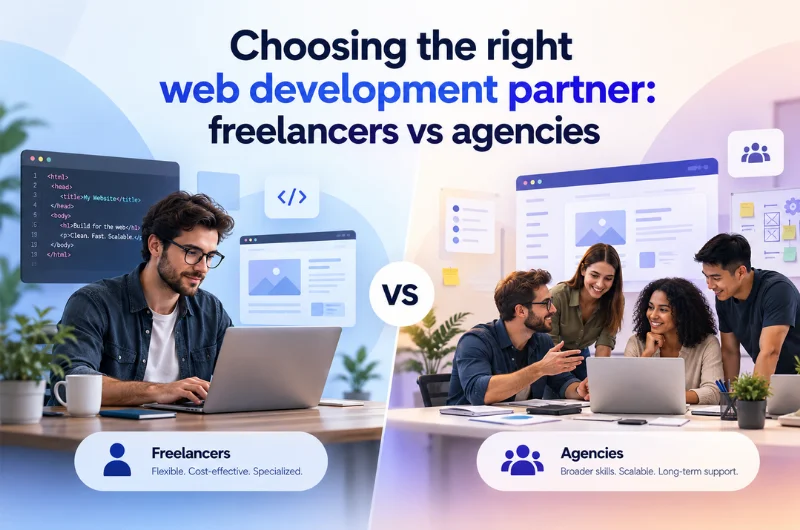
Choosing the right web development partner: freelancers vs agencies

You’ve decided your business needs professional web development and a website that actually works for you. Now you’re buried under quotes from freelancers on Facebook, polished pitch decks from agencies, and firms promising to handle everything from strategy to server maintenance. Quotes can vary widely, sometimes by a factor of three to five. The promises all sound identical. It’s exhausting, and it honestly feels that way by design.

Having worked with Nepali business owners across industries, including many that Webtech Nepal has partnered with directly over the past several years, a few patterns keep repeating. The businesses that get the best results aren’t necessarily the ones with the biggest budgets. They’re the ones who understood what they were actually buying before they signed anything, an observation that holds true across project types and budget levels. This article gives you that clarity.

What modern web development actually covers for your business

Website development today is far more than a few pages with your phone number and a contact form. Nepali businesses generally fall into one of these categories: a custom business website for service companies and professional firms; a web application for booking systems, portals, and role-based dashboards; or a full e-commerce store with product catalogs, payment gateway integration, and inventory management. The category you fall into shapes everything, who you hire, what you pay, and what the finished product needs to do.

One distinction worth understanding upfront: website design and web development are related but different disciplines. Design is how your site looks and feels, layouts, colors, navigation, and the overall user experience. Development is how it actually works, covering the HTML, CSS, and JavaScript on the front end, plus the server logic, database, and security layer on the back end. A partner worth hiring delivers both as a unified result, not two separate handoffs.

Beyond that, four things are non-negotiable for any Nepal-focused business competing online. Speed matters because slow pages lose visitors, especially users on mobile data networks. Security matters because SSL certificates, data protection, and secure payment handling are baseline expectations, not upgrades. SEO matters because your site needs to be found by the right people on Google, not just look good once someone already has the URL. And mobile-first design matters because a large and growing share of Nepali users browse on smartphones rather than desktop computers, a trend that shows no sign of reversing.

The honest difference between freelancers, agencies, and full-service firms

Freelancers are often skilled and genuinely affordable for small, well-defined projects. A single developer can build a clean website quickly and at a lower cost than a full team. The limitation is scope: many freelancers focus on a single area, front-end development or back-end development, and covering both at a consistently high level is less common. They typically don’t offer managed hosting, and many move on after launch. If something breaks six months later, or a plugin update crashes your site, you’re largely on your own.

A web agency typically assigns a team: a designer, a developer, and a project manager. That structure raises the quality ceiling for larger projects. But agencies vary significantly in how they handle post-launch responsibilities. Many hand you a finished site and close the project. If your hosting goes down or your site gets hacked, you start a new conversation, often with a new quote attached.

A full-service firm goes further. It handles everything from strategy and design through website development, hosting, security updates, SEO, and ongoing support, all under one roof. For a Nepali SME or tourism operator without an in-house technical team, this continuity is worth more than most businesses realize when they’re comparing upfront quotes. The relationship doesn’t end at launch; it continues as your business grows and your site needs to grow with it.

How to scope your project before you talk to anyone

Start with what the site needs to do

Before you request a single quote, nail down what you want the website to accomplish, who your primary audience is, and which features are non-negotiable versus which are nice-to-have. A tourism company targeting European trekkers needs multilingual content, fast image loading, and a functional inquiry form more than it needs an elaborate homepage animation. Knowing your priorities upfront stops you from overpaying for features you don’t need and under-specifying the ones that actually drive business.

Technology choices should match your business stage, not your partner’s preferred web development stack. A small business website is usually well-served by WordPress or a modern CMS, this keeps costs manageable and makes content updates straightforward. E-commerce projects often use WooCommerce or a custom-built solution depending on scale, with local payment gateways like eSewa and Khalti integrated from the start. Web apps and booking platforms require custom development using modern full-stack frameworks and a database that can handle real transactions reliably.

Build the foundations in from day one

Regardless of project type, mobile-first design, fast and reliable hosting, and an SEO-ready site structure should be built into the project from the beginning, not treated as features you add in a later phase that may never arrive. Retrofitting them after a site is live consistently costs more, in time and money, than building them correctly from the start.

What web development costs in Nepal: realistic pricing expectations

These 2026 price ranges for the Nepali market give you a useful benchmark before conversations begin. A professional small-business website runs approximately NPR 40,000 to 100,000, covering custom design, a CMS, lead forms, and basic SEO setup. A travel or trekking agency website with tour pages, galleries, inquiry forms, and multilingual content typically runs NPR 60,000 to 150,000. E-commerce stores with payment integration start higher and scale based on product volume and custom features. Advanced booking platforms with live availability and customer accounts can exceed NPR 300,000 to 500,000.

Very low quotes almost always point to the same underlying problems: template work with minimal customization, no SEO foundation built into the site structure, or no post-launch support included in the price. The cheapest option and the most expensive option are rarely the right answer. The right answer is transparent, itemized pricing from a firm that can explain what each line item includes.

Budget an additional NPR 11,500 to 46,000 per year for domain renewal, hosting, security updates, backups, and maintenance, depending on your site’s complexity and traffic. These costs catch many businesses off guard after launch. A partner offering managed hosting and maintenance bundles these expenses predictably, removing the anxiety of unexpected bills and ensuring your site stays secure and current without you having to manage it manually.

What professional website development delivered for a Nepali trekking company

Consider this representative scenario: a Nepali trekking and tourism operator whose website loaded in over six seconds on mobile, had no SSL certificate, no functional booking inquiry form, and ranked on page four of Google for its own company name. Inquiries came almost entirely through word of mouth. International visitors planning treks simply couldn’t find the business online, and those who did land on the site often left before scrolling past the first section.

After partnering with a full-service firm for a custom website rebuild, page load time dropped to under two seconds. Organic search traffic grew by over 200% within six months, driven by proper site structure, optimized content, and technical SEO foundations built into the project from day one. Inquiry volume from international visitors grew by more than 50%, turning a word-of-mouth operation into one with a functioning digital channel. These figures reflect agency-reported outcomes from the project; specific analytics data is available on request.

That outcome wasn’t accidental. It came from a team that treated speed, SEO, security, and mobile performance as foundational requirements, not features slated for a second phase that never happened. The difference between a site that generates inquiries and one that just exists online almost always comes down to decisions made during the build.

What to look for in a web development partner: credentials and continuity

Not all web development companies are equal, and credentials give you a practical way to separate firms with real capability from those with a well-designed sales deck. Look for companies listed on independent platforms like DesignRush or TechBehemoths, where clients leave reviews through third-party verification processes rather than testimonials the company drafted for itself. Look for technology partnerships that require demonstrated technical competency, for example, Microsoft’s Solutions Partner designations, which involve meeting capability scores, active certifications, and customer evidence requirements that go beyond basic enrollment. Look for a portfolio with outcomes described in business terms, not just screenshots of finished designs.

Webtech Nepal holds Microsoft Partner recognition, is listed and reviewed on both DesignRush and TechBehemoths with client feedback, and operates with transparent, itemized pricing so clients understand exactly what they’re paying for before any work begins. Managed hosting is included as a core offering, not an add-on, which means your site stays online, secure, and updated without you needing to source a new vendor every time something needs attention. The team works across industries: startups, SMEs, tourism and trekking operators, educational institutions, and SaaS businesses. That breadth of real delivery experience shows up in how projects are scoped and executed.

Post-launch support is built into the relationship by design, not bolted on as an afterthought. In practice, that means regular security updates, performance monitoring, and a point of contact when something needs attention, rather than starting a new project negotiation every time an issue arises. That distinction matters more than almost anything else when you’re evaluating who to trust with your business’s primary digital presence.

Making the right call for your business

Your website is your storefront, your sales representative, and your credibility signal, often the first thing a potential customer sees before deciding whether to reach out. The partner who builds it shapes how well it performs those functions, and for how long. Choosing the wrong partner doesn’t just mean a website you’re not proud of; it means recurring technical problems, hidden costs, and a site that isn’t growing your business the way it should.

Freelancers are the right choice for small, contained projects with a clearly defined scope and a client who has the time and capability to manage their own hosting and updates afterward. Agencies work well when you need a team and already have some internal technical oversight to coordinate with them. A full-service firm with proven credentials, transparent pricing, and genuine ongoing support is the right choice for most Nepali SMEs and tourism operators who want their web development handled properly without adding technical project management to their workload.

If you’re ready to talk through your specific project, Webtech Nepal is straightforward about what your site will need, what it will cost, and what results are realistic for your situation. Tell us what you’re building and we’ll give you an honest assessment, no commitment required.

Best Digital Marketing Agency in Nepal: How to Choose the Right One in 2026

If you’re searching for the best digital marketing agency in Nepal, this guide will save you time, money, and the frustration of signing with the wrong team. Picking the wrong agency costs more than money. It costs months of wasted ad spend, a website that still doesn’t convert, and the nagging feeling that your competitors are pulling ahead while you wait for results that never come. The good news is that Nepal’s agency market has matured significantly, and there are genuinely strong options for businesses across categories, from Kathmandu-based SMEs to trekking operators targeting international travelers.

This article gives you a vetted shortlist of the top agencies operating in Nepal right now, honest pricing in NPR, real patterns in results across business types, and a practical checklist you can use before signing anything. One company worth knowing from the start is Webtech Nepal, which sits at the intersection of web development and digital marketing, a combination that turns out to be more valuable than most buyers initially realize. More on that shortly.

What separates a great digital marketing agency from a mediocre one

Many agencies in Nepal advertise a full menu of services: SEO, PPC, social media, content, and analytics. The real question is whether they deliver results or just deliverables. An agency that sends you a polished monthly report while your traffic flatlines and your contact form stays quiet is a cost center, not an investment. Before you evaluate any agency on price or personality, get clear on what a strong agency actually does.

The five services that matter for most businesses are technical SEO, paid media (Google Ads and Meta Ads), content production, social media management, and performance analytics with reporting. Each one is a discipline on its own. A “full-service” agency that spreads thin across all five often does none of them well. For businesses with tight budgets, a focused specialist frequently produces better ROI than a generalist handling everything at half-capacity.

What services a full-service digital agency should actually offer

Technical SEO covers site speed, crawlability, structured data, and on-page optimization. Local SEO adds citation management, Google Business Profile optimization, and location-targeted content. PPC management means building and optimizing campaigns, not just setting them live and billing the retainer. Content production and social strategy are separate disciplines: one feeds search intent, the other builds awareness and engagement. Performance analytics ties it all together with clear KPIs, attribution, and reporting that connects spend to outcomes.

When reviewing proposals, ask specifically which of these services are included and which are upsold separately. “Content marketing” that amounts to two blog posts a month is not a content strategy. An agency willing to be specific about scope is already showing you something important about how they operate.

Why Nepal-specific expertise changes everything

A trekking company in Kathmandu is not trying to rank for Nepali-language searches alone. It needs to appear for high-intent English queries typed by travelers in the United States, United Kingdom, and Australia, searches like “best Annapurna trekking company” or “Nepal trekking packages 2026.” An agency applying a generic SEO playbook built for a different market will miss critical elements: the keyword strategy, link-building sources, and content structure for an international audience look completely different from a local Kathmandu business directory campaign.

E-commerce in Nepal adds its own layer of complexity: payment gateway integration, mobile-first optimization for users on lower-bandwidth connections, and an understanding of how Nepali buyers behave online. Agencies that have navigated these specifics before move faster and make fewer expensive mistakes. Experience with Nepal’s market is not a nice-to-have; it directly affects how quickly your campaigns generate returns.

How to choose the best digital marketing agency in Nepal

Before you shortlist any agency, decide what your business actually needs at this moment. A trekking company needs international SEO and a conversion-ready inquiry site. A Kathmandu e-commerce store needs mobile-first performance and a paid media strategy built around Nepal’s buying behavior. A startup needs a foundation before it needs a campaign. Matching your need to the right agency type is the single most important decision in this process.

The sections below group agencies by specialization so you can self-select based on fit, rather than chasing a generic “best” label.

Top digital marketing agencies in Nepal worth considering in 2026

The following is a practical shortlist, not an official ranking. Agencies are grouped by specialization to help you identify the right category for your business needs.

Performance and SEO-focused agencies

Digital Terai (Kathmandu, founded 2018) and Digipal Solutions (Kathmandu, founded 2020) both focus on search performance and paid media, with documented work in Google Ads and organic growth campaigns. JO Marketing (Mahalaxmi, founded 2023) is a newer entrant with a strong emphasis on measurable outcomes and performance marketing. These agencies are solid choices if your primary goal is campaign performance and traffic growth. One practical note: if your website needs rebuilding or structural SEO work, you may need a separate vendor for that, which adds coordination overhead.

Full-service and creative agencies

Lone Tree (Lalitpur), Digital Marketing Nepal (Kathmandu, founded 2020), Makura Creations (Lalitpur, founded 2013), and Chaitanya Design (Narayangarh, founded 2018) all blend branding, content, and social media with varying depths of performance marketing. Makura Creations’s longevity in the market and Chaitanya Design’s presence across Nepal and Australia make them worth evaluating for businesses that prioritize brand presence alongside growth. These agencies suit businesses that want creative direction and marketing execution under one umbrella. Before committing, request case studies specific to performance metrics, creative depth and campaign performance are different capabilities.

Web-integrated agencies that handle both site and marketing

This category is where the most overlooked efficiency gain lives. When your web development team and your marketing team are the same team, the website gets built for SEO and conversion from day one. There’s no back-and-forth between two vendors about why the landing page isn’t converting or why slow site speed is dragging down Quality Scores.

Webtech Nepal operates in this space, combining website development for tourism operators, e-commerce businesses, and SMEs across Nepal with SEO and digital marketing services designed around the same sites they build. For businesses that need both a high-performance website and a marketing engine to drive traffic, that combined approach removes a significant point of friction.

WebX Nepal (Kathmandu, founded 2017) also sits in this category, offering web development alongside digital marketing services. If you need a single accountable partner for both your web presence and your marketing results, this category deserves serious consideration.

Pricing reality: what digital marketing agencies in Nepal charge in 2026

Most businesses in Nepal either underestimate agency costs or overestimate what a low retainer actually buys. The cheapest agency almost never delivers the best ROI, and the most expensive one isn’t automatically the right choice either. What matters is transparent, itemized pricing tied to clear deliverables and KPIs.

Monthly retainer ranges by service type

The ranges below reflect current market rates observed across Nepal’s agency landscape in 2026, based on publicly available agency pricing and market benchmarks. Actual fees vary by agency size, deliverable volume, and campaign complexity.

  • SEO: NPR 15,000, 40,000 for basic local SEO; NPR 40,000, 80,000+ for competitive campaigns targeting high-volume or international keywords
  • PPC management (Google Ads / Meta Ads): NPR 15,000, 75,000 per month, with advertising spend billed separately directly to the platforms
  • Social media management: NPR 10,000, 25,000 for basic posting; NPR 45,000, 80,000+ for video, Reels, multi-platform, and paid-social support
  • Single-channel starting budget (small business): NPR 25,000, 45,000/month in service fees, plus ad spend
  • Combined SEO and social:NPR 45,000, 120,000/month depending on volume and competition

What to watch out for when reviewing proposals

Red flags show up in predictable ways. Agencies that refuse to separate management fees from ad spend are either hiding markup on media or lack the financial transparency you need to track ROI. Vague scope language like “up to 10 posts per month” tells you nothing about content quality, strategy, or posting schedule. Any proposal that skips reporting, KPIs, or performance benchmarks is signaling that accountability isn’t part of the service.

Lock-in contracts with no performance clauses are worth scrutinizing carefully. A confident agency with a strong track record doesn’t need to trap clients. Ask for itemized pricing, a clear breakdown of what’s included at each tier, and confirmation of who specifically will manage your account week to week.

What real results look like for different business types

Numbers without context mislead. The patterns below reflect observed outcomes when agency work is executed well across these business categories, not optimistic projections or cherry-picked outliers. Where timelines are cited, they align with industry benchmarks for SEO traction (typically three to six months for measurable organic gains).

Startups and SMEs: building a pipeline from scratch

A Kathmandu-based SME with a dated website and no organic presence typically sees the clearest gains when a site rebuild and SEO campaign run in parallel rather than sequentially. When the website is built for conversion alongside the campaign, paid traffic converts better because the landing pages are designed for it. Organic traffic from a three-month SEO push starts compounding around month four or five. Contact form submissions increase not because more people are arriving, but because the site now makes it obvious what to do next.

The core insight is straightforward: running marketing campaigns without a solid website foundation is like running water through a leaky pipe, volume doesn’t help if the structure can’t hold it. Building the pipe and the water supply together is the approach that web-integrated agencies like Webtech Nepal take, and it’s a meaningful differentiator for businesses that need both.

Trekking and tourism companies: ranking where international clients search

A trekking operator in Nepal targeting English-speaking travelers from North America and Europe needs content built around high-intent queries, searches like “Everest base camp guided tours,” “best Annapurna trekking company,” or “Nepal 14-day trekking itinerary”, combined with local SEO that validates the business’s physical presence and credibility in Nepal. This is not a single-channel strategy. It’s organic content supported by a strong Google Business Profile, backed by authoritative links from international travel sources and Nepali tourism organizations.

Businesses that execute this combination consistently tend to see inquiry volume and WhatsApp booking requests grow within four to five months, in line with standard timelines for organic SEO to build measurable traction. Seasonality will affect the data, so establishing baseline metrics before peak season matters. For tourism operators, an agency that builds the website and runs the marketing simultaneously ensures that site architecture, booking flows, and SEO structure are aligned from day one, not retrofitted after traffic starts arriving.

A practical checklist for evaluating any agency before you sign

The questions below are the ones most business owners skip in the excitement of a good sales conversation. They’re also the questions that separate agencies capable of delivering real outcomes from ones that are skilled at winning accounts and weak at keeping them.

Six questions every business owner should ask

  1. Can you share a case study with before-and-after traffic and lead numbers?Named clients and specific figures are the standard. Vague claims of “significant growth” are not.
  2. How do you separate your management fee from ad spend?The two should always be listed separately. If they’re not, ask why.
  3. What does your monthly reporting look like and what KPIs do you track?Ask to see a sample report from a current client. If they don’t have one to share, that’s informative.
  4. Do you have experience with businesses in my industry in Nepal?Generic digital marketing experience transfers partially. Nepal-specific industry experience transfers more directly and produces results faster.
  5. What happens to the work if I stop the retainer?Content, ad account data, and website access should belong to you. Confirm this in writing before signing.
  6. Who exactly will manage my account?Ask whether your day-to-day contact is a senior strategist or a junior coordinator. The answer matters significantly for strategy quality.

Green flags and deal-breakers to watch for

Green flags include named client references you can actually contact, transparent line-item pricing, a willingness to start with an audit or discovery phase before pitching a full retainer, and clear ownership of deliverables. Agencies that ask about your business goals before presenting a solution are showing you how they actually work.

Deal-breakers include guaranteed ranking promises (no one can guarantee rankings), proposals with no case studies attached, retainer scope so vague it’s unenforceable, reluctance to discuss ad spend separately from management fees, and any agency that pitches services before understanding what you’re trying to achieve. These aren’t negotiating tactics, they’re structural problems that will show up in your results.

Frequently asked questions about choosing a digital marketing agency in Nepal

How much should a small business in Nepal budget for digital marketing?

A realistic starting point for a single-channel campaign (either SEO or social media management) is NPR 25,000, 45,000 per month in agency fees, plus separate ad spend if you’re running paid campaigns. Combined SEO and social packages typically start around NPR 45,000/month. Going below these ranges usually means getting scaled-back deliverables or junior-level account management.

What’s the difference between an SEO agency and a full-service digital marketing agency in Nepal?

An SEO-focused agency concentrates on search rankings, technical site health, and organic traffic growth. A full-service agency covers SEO alongside paid media, social media, content, and sometimes web development. Full-service doesn’t automatically mean better, it depends on whether you need breadth or depth at this stage of your business.

How long does it take to see results from digital marketing in Nepal?

Paid campaigns (Google Ads, Meta Ads) can generate traffic within days of launch, though optimizing for cost-per-lead typically takes four to eight weeks. Organic SEO generally takes three to six months to show measurable traction, with compounding gains building from there. Social media results vary widely depending on content quality, consistency, and whether paid promotion is included.

Should I choose an agency that also builds websites?

For most businesses, yes, particularly if your current website needs structural work. When the same team builds your site and runs your marketing, the technical foundation, page structure, and content strategy are aligned from the start. Coordinating between a separate web developer and a marketing agency adds delays, cost, and gaps in accountability.

Choosing the right partner comes down to fit, not just features

Every agency on this list brings something genuine to the table. The question is whether what they do well matches what your business needs right now. Use the pricing benchmarks and checklist in this article as your starting point for any agency conversation, they’ll help you ask better questions and spot weak proposals faster.

Ultimately, selecting the best digital marketing agency in Nepal comes down to fit, transparency, and proven results. If you want a no-pressure starting point, the team at Webtech Nepal offers a free site audit and strategy consultation for businesses that want their web foundation and marketing strategy reviewed together, a useful first step regardless of which agency you ultimately choose, because understanding where your current digital setup is leaving results on the table is the most valuable thing you can do before signing anything. Reach out to the Webtech Nepal team to book that conversation and start your evaluation with real data in hand.

How to choose the best IT company in Nepal for your startup: criteria that matter

Finding the best IT company in Nepal for your startup takes more than a quick Google search. Nepal now has hundreds of IT firms, and many founders rely on a friend’s recommendation or whoever responded fastest to the inquiry form. That approach often leads to poor outcomes: projects run over budget, fall behind schedule, or stall entirely after launch when the development team goes quiet. That pattern is common enough to deserve a better framework.

This guide walks through how to evaluate and shortlist a Nepal-based IT partner for a web-focused project, whether you’re building an e-commerce store, a tourism booking site, or a startup MVP. By the end, you’ll understand what to look for, how the market breaks down by specialty, and which firms are worth contacting first, including Webtech Nepal, a web design and development agency serving startups and SMEs.

What most startups get wrong when picking a Nepal IT company

The mistakes happen before a single line of code gets written. They’re not careless decisions; they’re the result of evaluating the wrong signals under time pressure. The same missteps show up again and again.

Choosing on price alone

Nepal’s IT market runs from roughly $15/hr on the low end to $50+/hr for senior developers and technical leads. That range looks like an obvious cost-saving opportunity, but low quotes rarely account for revision rounds, post-launch bug fixes, or the cost of rebuilding work that wasn’t done right the first time. The difference between a $20/hr and a $35/hr developer often shows up not in the code itself but in communication quality, how scope changes are handled, and whether the delivery holds up six weeks after launch.

Skipping portfolio and case study review

A company’s portfolio is its proof of work, and it deserves more than a five-second glance. Look for real client URLs you can visit, industry-relevant projects such as e-commerce, tourism, or SaaS, and check whether the design and performance hold up on mobile. If a firm can’t point to live examples, that’s a signal worth taking seriously before you sign anything.

Ignoring post-launch support before signing

Most startups discover the post-launch support gap after go-live, not before. When a site breaks during a peak traffic event, or when a payment gateway throws an error, or when a content update causes a layout problem, if the development team is unresponsive at that moment, the cost of fixing it falls on you. Post-launch support is a contractual question to ask before signing, not a detail to sort out later.

How to pick the best IT company in Nepal: criteria that matter

Evaluating an IT firm doesn’t require a technical background. It requires asking the right questions and knowing what good answers look like. Four criteria matter more than anything else for web-focused projects.

Technology stack and capability depth

The right firm builds on modern frameworks, handles custom functionality without defaulting to out-of-the-box templates for everything, and has genuine UI/UX capability alongside development. Ask directly: what stack do you use, can you build custom features, and how do you handle mobile-first design? Vague answers here usually mean limited capability.

Pricing transparency and contract clarity

Pricing transparency matters more than the price itself. A firm that delivers a detailed, scope-based quote with revision terms, payment milestones, and defined deliverables is measurably less risky than one offering a vague low estimate. Among Nepal’s IT service providers, the firms that publish clear pricing models and put revision policies in writing tend to finish projects on time and without disputes, pricing clarity is a best-practice signal, not a guarantee, but it’s one of the most reliable indicators available.

Delivery track record and timeline commitments

On-time delivery is a meaningful differentiator, verify it by asking for client references, checking review timestamps on third-party platforms, and confirming whether listed case studies include actual delivery timelines. A company that cites delivery dates in its case studies treats timelines as commitments. When you review those studies, look for documented milestones, published start and end dates, and any client confirmation of on-time completion.

Post-launch support and managed hosting options

A solid post-launch package covers uptime monitoring, security patches, content updates, and a clear escalation path for bugs. Firms that bundle managed hosting alongside development remove a significant coordination burden for non-technical founders. You shouldn’t have to manage three different vendors to keep a website running after launch.

How Nepal’s IT market breaks down by specialty

Not every top IT company in Nepal serves the same customer. Understanding the market segments saves time and prevents mismatched expectations on both sides. Nepal software development companies range from large enterprise-focused firms to lean web agencies, knowing which segment fits your project scope is the first filter to apply.

Enterprise and sector-specific firms

Some of Nepal’s largest IT firms operate within specific verticals and serve regulated industries with large development teams. F1Soft dominates fintech and digital banking. Leapfrog Technology focuses on custom software and product development, with strong healthcare tech and enterprise capabilities. Fusemachines works in AI and machine learning. Deerhold specializes in healthcare analytics. These companies are capable within their verticals, but they’re generally not the right fit for a startup building its first website or an SME launching an online store.

Web design and development agencies for startups and SMEs

The segment most relevant to startups, e-commerce operators, and tourism companies is smaller web-focused agencies, firms that handle design, development, and digital presence from concept to launch without requiring a dedicated in-house team from the client. When evaluating best software companies in Nepal for this use case, look for industry-relevant portfolio work, SEO capability, e-commerce experience, and the ability to handle the full project lifecycle. This is where agencies like Webtech Nepal operate, and it’s the right lens for evaluating them.

Checklist: certifications and third-party credibility signals

ISO 27001 and CMMI certifications matter for enterprise outsourcing with regulated data requirements. For web-focused projects, the more practical signals are third-party directory listings on platforms like DesignRush and Clutch, partnership status with major technology providers, and verified client reviews. DesignRush publicly describes a vetting process that checks portfolios, case studies, business legitimacy, and client feedback before listing a company, use these sources as a pre-screening filter before reaching out to any IT firms in Kathmandu or elsewhere directly.

Why Webtech Nepal belongs on your shortlist

The case for Webtech Nepal isn’t built on marketing language. It’s built on the kind of project outcomes and operational practices that match what most startups and SMEs actually need.

Directory recognition and technical credentials

Third-party directory listings on platforms like DesignRush provide a layer of verification a founder can check independently, without taking anyone’s word for it. These directories screen companies against defined criteria before listing them, giving you a starting point that goes beyond a company’s own marketing claims. Before reaching out to any Nepal IT outsourcing companies, cross-referencing their third-party profiles takes less than five minutes and filters out firms that can’t meet basic credibility standards.

E-commerce and tourism project experience

Two project types represent the bulk of what startups and SMEs in Nepal need: e-commerce websites and tourism or trekking company sites. For e-commerce, a well-executed build means a custom storefront with secure local payment integration, mobile-first design, and an admin dashboard that a non-technical operator can actually use. For tourism clients, the project centers on SEO-optimized, inquiry-driven design built for international visitors, fast load times, and clear calls to action that convert traffic into bookings. Review Webtech Nepal’s portfolio directly to assess how their delivered work matches your project type, the specifics are worth verifying firsthand.

What makes the day-to-day working relationship smooth

Transparent pricing with no hidden revision costs and defined milestones are the practical differentiators that matter once the contract is signed. Add managed hosting that keeps the site maintained after launch and a dedicated support team that responds when something breaks, and you have the operating model worth asking about. These aren’t claims to take at face value, ask about each one directly, get the answers in writing, and verify them through reviews on third-party directories.

What Nepal IT companies typically charge in 2026

Pricing clarity before conversations start prevents wasted time on both sides. The Nepal IT market in 2026 runs across a well-defined range, and knowing the bands helps you identify when a quote is realistic and when it’s a signal to ask harder questions.

Hourly rates by seniority and project type

Junior and entry-level development runs around $15 to $25 per hour. Mid-level developers sit at $25 to $40 per hour. Senior developers and technical leads typically charge $35 to $55 per hour, with some specialist agencies going higher. For mobile app development, the typical build team range is $18 to $55 per hour. For web design and development agencies working on fixed-price projects, a professional business website or e-commerce build starts at roughly $5,000 and scales with complexity, integrations, and custom functionality.

What a realistic project budget looks like by scope

A professional startup or SME website with custom design, mobile responsiveness, and basic SEO typically falls in the $5,000 to $10,000 range. A custom e-commerce store with payment integration, product management, and an admin dashboard sits higher, estimates vary widely by catalog size and feature depth, with many directories citing ranges between $8,000 and $20,000. A tourism inquiry website with built-in SEO, multilingual consideration, and inquiry flow often lands in a similar range, commonly $6,000 to $12,000, though actual costs depend on scope. A firm offering significantly below-market quotes for complex builds often indicates trade-offs in areas such as design quality, testing, or post-launch support. Transparent, scope-based pricing is worth the modest premium.

How to shortlist, evaluate, and take the next step

The framework above points to a clear process. Here’s how to put it into action.

Three questions to ask any IT firm before you commit

These questions reveal how a firm actually operates, not just what it claims. First: how do you handle scope changes during a project? A good answer describes a defined change-request process with written approval and clear pricing. A bad answer is vague or dismissive. Second: can you share a client reference from a project similar to mine? A firm with genuine delivery experience will offer references without hesitation. Third: what does post-launch support look like, and is it included or charged separately? The answer should be specific, duration, coverage, response time, and cost. Anything vague should prompt a follow-up.

Checklist: choosing the best IT company in Nepal for startups

Before committing to any firm, run through this filter. Does the firm have a live, reviewable portfolio with projects relevant to your industry? Do they provide a detailed, scope-based quote rather than a vague estimate? Are their delivery timelines documented in case studies or client references? Is post-launch support defined in writing? And can you find them on at least one independent third-party directory with verified client reviews? A firm that clears all five of these checks is worth a deeper conversation.

How to start your evaluation with Webtech Nepal

The lowest-friction first step is to request a portfolio review or ask for a project quote. Before reaching out, look for Webtech Nepal’s listings on third-party directories directly, the verified reviews there give you an independent read on delivery quality, communication, and client experience before you invest time in a conversation. Treat this as the first step in a shortlist process, not a final decision. Share your project scope with the team and use the three questions above to evaluate the response.

Make your decision on evidence, not on instinct

The best IT company in Nepal for your startup is the one whose technical capability, pricing transparency, delivery record, and post-launch support align with your project’s actual requirements. It’s not the one with the lowest hourly rate or the longest list of services on its homepage. Among Nepal tech companies focused on web design, e-commerce, and digital presence, Webtech Nepal’s combination of relevant project experience, transparent operating practices, and third-party directory presence makes it a strong first contact on any shortlist.

Start with a portfolio review. Ask the three qualifying questions. Check the independent directories. Make your decision based on what you can verify, not what you’re told. That approach won’t guarantee a perfect outcome, but it eliminates most of the regret.

Microsoft 365 Business Basic vs Standard vs Premium: Which plan fits

Choosing the right Microsoft 365 Business Basic plan is a frequent challenge for Nepalese startups and SMEs, and it’s easy to see why. Microsoft’s 365 business lineup looks straightforward until you’re actually choosing between three plans with nearly identical names, overlapping feature lists, and real pricing differences that add up fast when you’re paying per user. Basic sounds right until you’re not sure what “web apps only” actually means for your team’s daily work. Standard sounds safer but costs nearly double. And Premium sounds like something reserved for large enterprises with a dedicated IT department.

The frustration is real, and the wrong choice is expensive in both directions. Buy too little and your team hits limitations within weeks. Buy too much and you’re paying for security features a five-person team doesn’t need yet. Some local businesses work with a Microsoft Partner like Webtech Nepal to make this call correctly from day one, especially when domain configuration and email migration are part of the picture. This article walks you through exactly what each plan covers, where Microsoft 365 Business Basic falls short, and how to get set up without losing email continuity in the process.

What Microsoft 365 Business Basic actually includes

Core apps and services you get

Business Basic (formerly Office 365 Business Basic) delivers web and mobile versions of Word, Excel, PowerPoint, and Outlook, but no locally installed desktop applications. That distinction matters more than it sounds. You also get Exchange Online for custom business email, Microsoft Teams for chat and video meetings, OneDrive for cloud file storage, SharePoint for team document collaboration, and additional tools including Planner, Bookings, and Forms. “Web and mobile apps only” is the defining characteristic of this tier, and every other plan comparison flows from that single fact.

Microsoft 365 Business Basic: pricing and commitment options in 2026

After Microsoft’s July 2026 pricing update, Business Basic is $7.00 per user per month on an annual commitment or $8.40 per user per month on a month-to-month basis. (Check Microsoft’s current pricing page to confirm these figures, as list prices can vary by region and reseller.) The plan covers organizations with up to 300 users across the Business plan family. For a ten-person team on the annual plan, that works out to $840 per year, meaningful for a startup watching every line of its operating budget.

Storage and mailbox limits

According to Microsoft’s Exchange Online service documentation, each user gets a 100 GB mailbox, shared mailboxes are capped at 50 GB, and OneDrive provides 1 TB of cloud storage per user. For most startups and small teams, these limits are generous enough to grow into for several years. The mailbox limit is worth tracking if you’re migrating from a host that offered unlimited email storage, since some teams accumulate more than 100 GB in legacy accounts over time.

Business Basic vs Business Standard vs Premium: where each plan draws the line

The desktop apps gap that most businesses miss

Business Standard’s primary addition over Basic is simple: locally installed desktop versions of Word, Excel, PowerPoint, and Outlook. Teams who use Excel for complex financial modeling, build large formatted Word documents, or work in areas with unreliable internet access will feel the gap within weeks of running Basic. Browser-based Office apps are capable, but they don’t match the performance or feature depth of the desktop versions for heavy daily use. If your team’s core work runs through Office apps rather than around them, this gap is the deciding factor.

Security and device management: where Premium is a different category

Business Standard does not add meaningful security features over Basic. The foundational security baseline is largely the same across both plans, which surprises many business owners who assume “more expensive” means “more secure.” The real security jump happens at Business Premium, which adds Intune device management, Azure Information Protection, and advanced threat protection tools. Most Nepalese SMEs don’t need those capabilities at launch, but it’s worth knowing what you’re not getting before a security incident makes that decision for you.

Feature comparison at a glance

The table below captures the key differences across all three plans so you can see the full picture in one place.

Feature Business Basic Business Standard Business Premium
Desktop Office apps No Yes Yes
Web and mobile apps Yes Yes Yes
Exchange Online (custom email) Yes (100 GB) Yes (100 GB) Yes (100 GB)
OneDrive storage 1 TB/user 1 TB/user 1 TB/user
Microsoft Teams Yes Yes + webinar features Yes + webinar features
SharePoint Yes Yes Yes
Intune device management No No Yes
Azure Information Protection No No Yes
Price (annual, per user/month) $7.00 $14.00 ~$22.00 (verify current pricing)

Which plan actually fits Nepalese startups and SMEs

Microsoft 365 Business Basic is the right starting point when…

Business Basic works well for teams that primarily work through a browser or on mobile devices, businesses moving from free Gmail or personal email addresses to a professional Microsoft infrastructure, and startups that need Teams for collaboration and OneDrive for file sharing without the added cost of desktop app licenses. It’s also the right call for organizations under 50 users that need to keep per-seat costs lean. If your team’s daily workflow doesn’t depend on heavy offline Office app usage, Business Basic covers everything you need.

When to move to Business Standard instead

If your team runs Excel-heavy reporting, edits large Word documents daily, or regularly works in locations with unreliable internet, Basic will frustrate them quickly. Business Standard at $14.00 per user per month (after the 2026 pricing update) is the right call for those workflows. Standard also adds meeting and webinar capabilities in Teams, per Microsoft’s plan comparison documentation, that client-facing businesses find genuinely useful, particularly for service companies running online consultations or training sessions.

Is Business Premium worth it for most SMEs?

For most Nepalese SMEs at the startup or small business stage, Business Premium is premature. It’s built for organizations that need centralized device management, compliance tooling, and advanced security policies across a managed fleet of devices. It makes sense to revisit Premium when your team grows past 50 users, when you’re handling sensitive client data at scale, or when regulatory requirements demand it. Starting there adds cost and complexity before you’re ready to use what you’re paying for.

Setting up Microsoft 365 Business Basic step by step

Activating your subscription and adding users

Start in the Microsoft 365 admin center by navigating to Billing, then Your products, and confirming that Business Basic shows as Active. From there, go to Active Users, add each team member, and assign them a Business Basic license. Once users are added, return to the admin center home, open Dashboard view, and select Go to Guided Setup to begin the configuration flow. The guided setup walks you through domain connection, email setup, and app activation in a structured sequence.

Connecting your custom domain and configuring DNS

Adding a custom domain to Microsoft 365 Business Basic requires four DNS changes on your domain registrar or hosting control panel:

  • Add aTXT recordto verify domain ownership with Microsoft
  • Update yourMX recordso inbound email routes to Exchange Online
  • Add aCNAME recordpointing autodiscover to autodiscover.outlook.com
  • Publish anSPF recordauthorizing Microsoft to send on your domain’s behalf

This is where most businesses hit trouble, especially when the domain registrar, hosting provider, and email setup are managed by different parties with different control panels. Webtech Nepal manages DNS configuration across both the domain and hosting environment together, which eliminates the handoff problems that typically cause email downtime during migration.

Finishing email, Teams, and OneDrive setup

Once DNS records propagate, complete the Outlook and Exchange Online configuration so each user can send and receive on their custom domain address. Set up Teams by walking the team through the desktop or mobile app installation and running a test call. Walk employees through OneDrive sync on their devices so files are accessible locally and in the cloud simultaneously. A staged rollout is completely valid here: activate services in phases rather than switching everything at once, which reduces disruption and gives staff time to adapt to each tool before the next one goes live.

Connecting Microsoft 365 to your business website

Setting up professional email on your custom domain

Once your domain is verified in Microsoft 365, email addressed to yourname@yourbusiness.com.np routes cleanly through Exchange Online. The critical step is ensuring the DNS records on your domain are configured correctly before the MX record points to Microsoft, so no mail is lost in transit. When Webtech Nepal handles both website setup and Microsoft 365 configuration, your email and website infrastructure are aligned from the first day the site goes live, eliminating the MX record conflicts that commonly break email delivery for businesses attempting to self-migrate while also launching a new site.

Embedding Teams and SharePoint into your website

A service business can embed a Teams meeting booking link directly on its contact or services page, letting visitors schedule calls without navigating away from the site. A client portal page can surface a SharePoint document library so clients access reports, contracts, or project files through the website. Note that SharePoint content typically requires appropriate Microsoft 365 permissions, so users may still need to sign in depending on how access control is configured. These integrations require coordinating the Microsoft 365 setup with the website build so both environments work together from launch.

Automating workflows between your website and Microsoft 365

Power Automate connects website events to Microsoft 365 actions without requiring custom code. A contact form submission on your website can automatically post a notification to a Teams channel and create a task in Planner for the relevant team member to follow up. A booking form can feed directly into a SharePoint list your team uses to track leads and service requests. Setting up these automations during the website build, rather than as an afterthought months later, means the workflows are live from day one, before teams are already overwhelmed with other priorities.

How Webtech Nepal migrates and supports local businesses on Microsoft 365

Migration planning and DNS management

A migration from cPanel hosting, Google Workspace, or personal email accounts to Microsoft 365 involves more than flipping a switch. The most common failures happen because the domain’s authoritative nameservers point to a different provider than where DNS records are being edited, because old MX or SPF records from the previous provider are still active, or because cPanel’s email routing setting wasn’t switched from local to remote before the MX cutover.

Webtech Nepal audits the existing email environment, builds a cutover plan that keeps email live through the transition, and manages DNS changes across the domain registrar and hosting environment simultaneously. Handling both the Microsoft 365 setup and managed hosting under one roof means both sides of the DNS equation stay coordinated, which is where self-managed migrations most often break down.

Ongoing training, support, and managed hosting

Getting the subscription active and DNS configured is only the first step. Without hands-on training, most teams revert to old habits: email threads instead of Teams channels, USB drives instead of OneDrive, and email attachments instead of SharePoint links. Webtech Nepal provides staff training so the tools your team paid for actually get used. Ongoing support covers subscription renewals, license adjustments as headcount changes, and integration updates when the website is upgraded or redesigned. Having Microsoft 365 management and website maintenance under one provider keeps costs predictable and support responsive, which matters most for Nepalese businesses without a dedicated IT team to manage these systems internally.

The right plan, set up correctly from day one

For most Nepalese startups and SMEs, Microsoft 365 Business Basic is the right entry point: professional email on a custom domain, Teams for collaboration, OneDrive for file storage, and web-based Office apps, all at $7.00 per user per month. If your team works heavily in Excel or Word offline, step up to Business Standard. If centralized device management and advanced security are on your radar, that’s when Business Premium enters the conversation.

The decision itself is straightforward once you know what each plan actually does. The harder part is getting the DNS configuration right, keeping email live through the migration, and making sure the subscription is connected to your website and domain properly. That’s where getting it wrong costs time and customers.

If you’re ready to get your Microsoft 365 Business Basic environment set up correctly, reach out to our team at Webtech Nepal for a migration assessment. We’ll review your current email setup, map out the DNS configuration, and move your team onto professional Microsoft 365 infrastructure without any downtime.

Frequently asked questions about Microsoft 365 Business Basic

Is Microsoft 365 Business Basic enough for a Nepalese startup?

For most early-stage teams, yes. Business Basic covers professional email on a custom domain, Microsoft Teams, OneDrive, SharePoint, and web-based Office apps. If your team doesn’t rely on heavy offline Excel or Word usage, you won’t outgrow it quickly, and the per-seat cost is the most manageable in the Business plan family.

What’s the difference between Business Basic and Business Standard?

The primary difference is locally installed desktop apps. Business Standard includes installable versions of Word, Excel, PowerPoint, and Outlook. Business Basic does not. Standard also adds Teams webinar capabilities. Both plans include the same mailbox size, OneDrive storage, SharePoint, and core security baseline.

Can I upgrade from Business Basic to Standard later?

Yes. Microsoft allows mid-cycle plan upgrades through the admin center. You can move individual users or your entire organization to a higher plan at any time. Upgrading mid-year typically results in a prorated charge for the remaining commitment period.

Does Business Basic include a business email address?

Yes. Every Business Basic license includes Exchange Online, which lets you send and receive email on a custom domain (for example, yourname@yourbusiness.com.np). Setting this up requires verifying the domain in the Microsoft 365 admin center and updating your DNS records.

How long does migration from cPanel or Gmail to Microsoft 365 take?

A straightforward migration for a small team typically takes one to three business days when DNS is managed cleanly. More complex environments, multiple domains, large mailboxes, or conflicts between legacy DNS records, can take longer. Planning the cutover carefully and auditing existing DNS records before making changes is what keeps email live through the transition.

Top SEO Experts in Nepal: Agencies and Freelancers That Deliver Results

If you’re searching for an SEO expert in Nepal, you already know the frustration: a crowded market full of providers promising page-one rankings, and no reliable way to tell the skilled ones apart from those who’ll disappear with your retainer. Nepal’s businesses are moving online at a faster pace each year, and demand for search visibility has outpaced the supply of practitioners who can actually deliver it. After more than a decade building and marketing websites for Nepali businesses at Webtech Nepal, we’ve watched the same pattern repeat: a business owner hires someone who promises page-one rankings, pays three months of retainer, and ends up with a stack of keyword reports and zero traffic growth. The problem isn’t that skilled SEO professionals don’t exist in Nepal. They do. The problem is knowing how to tell them apart from the ones who take your money and go quiet.

This guide gives you a practical framework for doing exactly that. You’ll learn what good SEO actually looks like for Nepal’s market, what services and realistic pricing to expect in 2026, how to spot weak providers before you sign anything, and which interview questions separate genuine expertise from surface-level talk. By the end, you’ll be able to evaluate any SEO agency or freelancer in Nepal with confidence.

What Nepali businesses actually need from SEO right now

Local search and Google Maps visibility

For most service businesses in Kathmandu, Pokhara, and other Nepali cities, Google Maps visibility produces faster, more measurable returns than chasing broad organic rankings. A customer searching “best hotel Thamel” or “accountant Lalitpur” is ready to act. Google Business Profile optimization, NAP consistency across directories, local citation building, and review volume are the levers that control map-pack rankings, and they’re often more achievable in a shorter timeframe than ranking for generic informational keywords.

The GBP signals that move the needle most are primary category accuracy, photo recency, review quality, and a consistent service description. Competition in Kathmandu is intense, which means a fully optimized profile with active reviews can still outrank a competitor with more history but a neglected listing. In Pokhara, that gap tends to widen because local competition is generally softer, making local SEO Nepal optimization even higher-ROI for businesses there.

Multilingual targeting for tourists and international visitors

Nepal’s tourism and trekking sector serves two largely distinct search audiences. International travelers booking an Annapurna Circuit trek or searching “Everest Base Camp cost” are querying in English with high commercial intent. Local operators searching for supplies or partners might search using the Nepali language. A site that treats both audiences the same will underperform with both.

Proper multilingual SEO means separate URL structures for each language version, correctly implemented hreflang annotations, and content that matches the search intent of each audience, not just a translated copy of the same page. International trekking keywords like “15-day Everest Base Camp trek cost” or “best time Annapurna trek” require detailed itinerary pages, safety credentials, and booking-intent signals to rank. Generic content does not win these positions.

Technical performance as a ranking foundation

Slow load times, failing Core Web Vitals, and broken mobile layouts are among the most common issues we find when auditing Nepali business websites. Uncompressed images, overloaded shared hosting, too many plugins, and render-blocking scripts are the usual culprits. These problems don’t just frustrate visitors; they limit how much any other SEO work can accomplish.

Before a content or link-building strategy can deliver results, the technical foundation has to be solid. Google won’t rank a crawlability mess, regardless of how many blog posts you publish or backlinks you earn. Technical SEO is not optional. It’s the prerequisite.

What a qualified SEO expert in Nepal should actually deliver

Technical audit, on-page optimization, and content strategy

A competent SEO engagement starts with a full technical audit: crawlability and indexation review, page speed and Core Web Vitals analysis, title and meta tag audit, mobile usability check, schema markup assessment, and a prioritized action list. “Prioritized” matters here because not every technical issue carries equal impact. A good provider knows which fixes unblock the most ranking potential first.

On-page and content work follows: keyword mapping to the right pages, content gap analysis against ranking competitors, optimized title tags, structured headings, internal linking improvements, and where needed, new content targeting underserved queries. A clear content calendar tied to business goals, not just keyword volume, is what separates a real content strategy from a publishing schedule.

Link building, local citations, and off-page authority

Ethical off-page SEO means earning links from relevant websites through guest placements, digital PR, and editorial outreach, not buying link packages from link farms or private blog networks. Citation consistency across local directories builds the trust signals that reinforce Google Business Profile rankings. These are slow-build tactics, but they produce durable authority that cheap link schemes can’t replicate without risking a manual penalty.

Any provider who can’t explain their specific link-building process in plain terms is either winging it or hiding something you wouldn’t approve of. Ask the question directly, and listen for a concrete answer rather than vague reassurances about “quality links.”

Reporting that connects rankings to real business outcomes

Monthly reports should track more than keyword positions. A solid report covers organic traffic trends from Google Analytics, Search Console impressions and click data, conversion attribution from organic sessions, competitor movement on shared keywords, and a clear plan for the next 30 days. Rankings are a signal; traffic, leads, and revenue are the result you actually hired SEO services in Nepal to produce.

If a provider sends you a rankings PDF without connecting it to any business metric, they’re optimizing for the appearance of progress rather than the reality of it. Push for reports that show business impact, not just position changes.

How to hire an SEO expert in Nepal: realistic pricing for 2026

Freelancer rates vs. agency retainer costs

Here’s what the market actually looks like when you hire an SEO specialist in Nepal in 2026:

Provider type Hourly rate Monthly retainer
Freelance SEO Nepal specialist NPR 1,500, 8,000/hr NPR 15,000, 40,000/mo
SEO agency NPR 3,000, 5,000/hr NPR 25,000, 80,000/mo

The wide range within each tier reflects real differences in what’s included. A NPR 15,000/month freelancer retainer typically covers basic on-page optimization and rank tracking. A NPR 60,000, 80,000/month agency engagement usually includes technical SEO, content production, link building, local SEO, and full reporting. The price jump isn’t markup; it’s scope.

What each price tier realistically gets you

At the lower end of the freelance SEO Nepal range, you’re generally getting keyword research, title tag and meta description updates, and a monthly rankings report. Content creation and link building are rarely included. That’s not a knock on affordable freelancers; it’s just what those hours can cover. If content and links aren’t in scope, you need to budget separately or accept slower momentum.

Mid-to-upper agency retainers in the NPR 50,000, 80,000 range typically include a dedicated team covering technical work, two to four content pieces monthly, active link building, and full analytics reporting. For businesses in competitive sectors like trekking, hospitality, or e-commerce, that fuller scope is often what it takes to move competitive keywords. Matching budget to realistic expectations upfront saves everyone a great deal of frustration.

Red flags that reveal an unreliable SEO provider

Guaranteed rankings and instant results

No legitimate SEO professional guarantees “#1 on Google” or “page one in 30 days.” Google’s ranking algorithm is not within anyone’s control. Any provider making those promises is either unaware of how search algorithms work, or they know exactly what they’re promising and plan to deliver nothing of substance. Either version is a problem.

Realistic timelines for Nepal local business keywords look like this: low-competition local terms can start showing movement in 6, 10 weeks, while more competitive industry terms typically take 3, 5 months. Campaigns showing meaningful organic traffic growth generally land in the 3, 6 month window. Any SEO expert for Nepali businesses who skips that conversation is selling you something they can’t deliver.

No verifiable portfolio, vague reporting, and locked-out data

A provider who can’t show before-and-after case studies with real traffic data has no track record worth trusting. Testimonials alone don’t prove performance; metrics do. Ask for case studies that include the baseline, what was done, and the measurable outcome. If the response is a vague reference to “many successful clients” without specifics, that’s your answer.

Watch especially for providers who insist on controlling your Google Analytics or Search Console access. Your own data belongs to you. Any provider who won’t grant you direct access to your accounts and instead shares only sanitized screenshots is hiding the full picture, and that’s never a sign of confidence in their own results.

Black-hat shortcuts and one-size-fits-all packages

Link farms, private blog networks, keyword stuffing, and comment spam are still sold in cheap Nepal SEO packages. These tactics can produce short-term ranking movement followed by a Google penalty that wipes out months or years of organic traffic. Businesses that get burned this way often don’t connect the penalty to the black-hat package they purchased six months earlier.

Equally problematic are generic bundled packages that don’t account for your business’s actual competition, keyword opportunity, or goals. SEO strategy is not a commodity. A trekking company in Pokhara needs a fundamentally different approach than an e-commerce retailer in Kathmandu. A provider offering the same package to both has no real strategy for either.

How to vet SEO candidates before you commit

Interview questions that separate real expertise from surface knowledge

These six questions reliably distinguish practitioners from people who have read about SEO without doing it:

  • “Walk me through an SEO audit you ran. What did you find, and what changed afterward?”A strong answer includes specific issues found, the prioritization logic, and measurable outcomes. A weak answer stays generic.
  • “If organic traffic dropped 25% last month, what are your first five checks?”This reveals diagnostic thinking. Strong answers go to Search Console, algorithm update timelines, technical crawl issues, manual actions, and competitor movement.
  • “Show me a campaign where your SEO work produced business results, not just rankings.”Rankings are intermediate metrics. A competent practitioner knows how to connect their work to traffic, leads, or revenue.
  • “How do you evaluate whether a backlink is worth pursuing?”This surfaces link-building judgment and reveals whether they understand quality signals versus volume chasing.
  • “How would you explain an SEO recommendation to a developer who doesn’t want to make the change?”Communication and cross-functional influence are real parts of the job.
  • “What’s your process for mapping keywords to specific pages?”Keyword mapping is foundational. Vague answers here usually mean vague execution.

A practical checklist before you sign anything

Use this to evaluate any SEO provider before committing to a contract:

  • Verified case studies with baseline traffic or conversion data, not just claims
  • Direct access granted to your own Google Analytics and Search Console accounts
  • Transparent monthly reporting with a defined deliverable list included in the contract
  • No long-term lock-in without performance milestones tied to deliverables
  • A clear explanation of their link-building process and content creation workflow
  • A defined onboarding process that includes a technical audit before strategy recommendations

Why Webtech Nepal works as a long-term digital growth partner

SEO without a solid website is like advertising a broken store

Most standalone SEO engagements hit a ceiling at some point because the site’s technical foundation limits what’s achievable. Core Web Vitals failures, hosting environments that can’t handle traffic spikes, CMS configurations that create duplicate content by default, or a page architecture that buries key service pages all act as hard limits on organic growth. Fixing those issues requires development access, not just SEO knowledge.

At Webtech Nepal, SEO is built into the development process from the start. Managed hosting, site speed optimization, mobile performance, and technical architecture are handled by the same team doing the marketing work, a model we’ve applied consistently across client engagements. That integration removes the coordination friction that slows down most standalone SEO campaigns and means technical fixes actually get implemented rather than sitting in a developer’s backlog.

Representative results from Nepal businesses

Here are representative outcomes from recent client campaigns: a tourism operator in Pokhara saw organic inquiries double within five months of a combined technical overhaul and local SEO campaign. A Kathmandu-based service business moved from near-zero organic traffic to over 2,000 monthly visitors in the same timeframe, with qualified leads increasing in direct proportion. An e-commerce client saw a 70% increase in sales attributed to organic search after technical fixes cleared the Core Web Vitals failures that had suppressed their visibility. These are client-reported outcomes; full before-and-after data is available on request.

We don’t ask you to take these results on faith. Ask us for the supporting data and we’ll walk you through it.

Get a free site audit and see exactly where you stand

Webtech Nepal offers a free technical site audit that identifies your current SEO gaps, page speed issues, and local visibility problems. You’ll receive specific findings, not a sales presentation dressed up as analysis. If there are crawlability problems limiting your indexed pages, Core Web Vitals failures suppressing your rankings, or Google Business Profile gaps hurting your map-pack visibility, the audit will show you exactly what they are and what it would take to address them.

Reach out to our team to request your free audit. It’s a no-risk way to get a professional assessment of where your site actually stands before you commit to any retainer with anyone.

How to find and hire the right SEO expert in Nepal

The gap between the best and worst SEO providers in Nepal is genuinely wide. Skilled freelancers and strong agencies exist, but so do providers selling guaranteed rankings, low-effort link packages, and monthly reports that say nothing. The difference isn’t always obvious from a sales conversation, which is why the checklist and interview questions in this guide matter.

Finding the right SEO expert in Nepal comes down to verifiable proof of results in comparable situations, transparent pricing tied to defined deliverables, and a provider whose work integrates with your broader digital setup rather than operating in isolation. Use the framework here to filter fast, and don’t skip the audit step before committing.

If you want a team with a proven track record of building and marketing Nepali businesses online, Webtech Nepal is ready to show you exactly what’s holding your site back and what it would take to fix it. Start with the free audit and go from there, hire an SEO expert in Nepal who can demonstrate results, not just promise them.

Frequently asked questions about hiring an SEO expert in Nepal

How much does an SEO expert in Nepal cost?

Freelance SEO Nepal specialists typically charge NPR 1,500, 8,000 per hour or NPR 15,000, 40,000 per month on retainer. SEO agency retainers generally run NPR 25,000, 80,000 per month depending on scope. The difference in cost reflects the difference in deliverables, a lower retainer usually means basic on-page work, while higher-tier engagements include technical SEO, content production, and active link building.

How long does it take to see results from SEO services in Nepal?

Low-competition local keywords can start moving within 6, 10 weeks. More competitive terms typically take 3, 5 months before meaningful ranking improvement is visible. Campaigns producing sustained organic traffic growth generally show clear results within the 3, 6 month window. Any provider promising faster guarantees should be treated with skepticism.

What should I look for when choosing a Nepal SEO agency?

Verified case studies with real traffic data, transparent reporting tied to business metrics, direct access to your own analytics accounts, and a clear explanation of their link-building process are the non-negotiables. Avoid any agency that promises guaranteed rankings or won’t show you concrete examples of past performance.

How to Choose Best SEO Company in Nepal: A Practical Checklist for SMEs

If you’re evaluating an Best SEO company in Nepal, you already know the pitch: page-one rankings, guaranteed results, fast turnarounds. Every agency makes the same promises. The reality is that results vary widely, and for an SME working with a limited budget, a bad hire can burn months and significant budget on activity reports that never move the needle. The market has enough noise to trip up even experienced business owners who’ve hired vendors before.

Some firms in Nepal genuinely deliver. Webtech Nepal, for example, has built repeatable SEO processes tied to solid technical web infrastructure rather than keyword stuffing, an approach that matters more than most SMEs realize when they’re first evaluating proposals. Understanding what separates firms like this from the noise is exactly what this guide is designed to help you do.

This guide covers what services to expect from a credible SEO agency in Nepal, how pricing breaks down by business size, how to read proof of results, and a vetting checklist built for 2026. By the end, you’ll be able to shortlist three to five agencies and walk into every discovery call knowing exactly what to ask.

What a legitimate SEO agency in Nepal actually delivers

A real Nepal-based SEO company offers more than monthly keyword reports. Any agency worth hiring should cover four service pillars consistently, and if one of them is missing from the proposal, that’s a gap worth questioning before you sign anything.

Technical SEO and site health

Technical SEO covers the infrastructure your rankings depend on: crawlability, Core Web Vitals, schema markup, XML sitemap health, mobile optimization, and canonical tag management. These aren’t optional extras. Based on market-rate research, agencies offering “full SEO” for under NPR 10,000 per month rarely cover technical work properly, because it takes time and specific expertise to do well. Even in the NPR 15,000 to 20,000 range, verify exactly which technical deliverables are included before you commit.

Content strategy and on-page optimization

On-page work includes keyword-targeted page rewrites, meta structures, internal linking improvements, and content briefs for blog posts or landing pages. Content without technical grounding rarely ranks in competitive niches because search engines can’t properly crawl and interpret pages that have structural problems underneath the writing.

Local and international link-building

Local citation building covers Google Business Profile optimization, NAP consistency across directories, and placements in Nepali business directories. International outreach includes editorial placements, guest posts, and press releases targeting relevant publications. SMEs in tourism, export, or businesses targeting diaspora audiences need both. A realistic link-building timeline is three to six months before you see the authority gains reflected in rankings.

What to budget: SEO pricing by business size in Nepal

Before you request a proposal, knowing the market rate saves you from two problems: overpaying for a basic package, or being drawn to a suspiciously cheap offer that signals low-quality work. Here’s how 2026 pricing breaks down in practice.

Small clients should expect to spend NPR 15,000 to 40,000 per month for local SEO basics, covering keyword research, on-page fixes, and Google Business Profile optimization. Medium-sized businesses running growth campaigns with content production and link-building land in the NPR 35,000 to 80,000 per month range. Enterprise clients with competitive keywords, multiple locations, or large e-commerce catalogs typically budget NPR 75,000 to 300,000 or more per month.

For SMEs that aren’t ready to commit to a retainer, project-based engagements make sense as a starting point. A technical audit with on-page cleanup runs NPR 15,000 to 30,000 as a one-off. For sustained organic growth, though, retainers win: SEO compounds over time, and campaigns that stop after one project lose momentum quickly.

One structural advantage Nepal-based SEO firms offer is a significant cost differential compared to equivalent US or UK agencies. The same level of senior-level strategy that would cost $2,500 to $5,000 per month in Western markets is accessible at a fraction of that through a credentialed Nepal agency. The caveat is that “credentialed” is doing real work in that sentence.

How to verify an SEO company in Nepal actually delivers results, not just reports

This is where most SMEs get burned. Agencies produce activity reports full of keywords tracked and tasks completed, while organic traffic stays flat and leads don’t move. Learning to demand proof of outcomes rather than activity changes how you evaluate every proposal you receive.

Reading case studies and client reviews critically

Platforms like Clutch and GoodFirms are among the more reliable sources for agency reviews. Clutch explicitly verifies business registration, legal history, and client feedback before a provider earns certification badges, which require three or more verified, high-rated reviews within the past 24 months. That standard is meaningfully different from a generic five-star rating on a website the agency controls. GoodFirms is useful for initial research but applies a less rigorous verification process, so treat listings there as a starting point rather than a final filter.

When reading reviews, look for specifics. A review that says “they boosted our visibility” tells you almost nothing. A review that says “we went from 800 to 2,400 monthly organic sessions in five months, and inbound inquiries increased by 28 per month” gives you something to calibrate against. Agency-published case studies from Nepal-based SEO providers have documented results including 200% or more organic traffic growth within six months and 15-plus keywords reaching top-three positions. Treat these figures as illustrations of what well-executed campaigns can achieve, and always ask whether a case study was independently verified or self-reported by the agency.

KPIs to agree on before signing any contract

Before you commit, the agency should agree in writing to track and report: organic sessions, keyword position movement, domain authority growth, click-through rate from search, and conversion events including form fills, calls, and purchases. Any agency that only reports on impressions or “visibility scores” without connecting them to business outcomes is optimizing for reports that look good rather than results that matter.

Why combining SEO with web design fast-tracks your rankings

Verifying an agency’s results and process is only half the equation. The other half is making sure the platform your SEO runs on isn’t working against you. Most SMEs hiring a standalone SEO company in Nepal still have a slow, outdated, or technically broken website. The SEO work gets undermined by infrastructure problems the agency didn’t build and won’t fix. You end up paying for optimization layered on top of a foundation that’s actively working against you.

The integrated advantage: what an all-in-one model looks like in practice

Webtech Nepal addresses that gap by handling web design, development, SEO, managed hosting, and ongoing support under one roof. When the same team that built your site is also running your SEO campaign, technical optimizations like page speed, Core Web Vitals, SSL configuration, and structured data implementation happen faster and more cohesively. There’s no back-and-forth between a developer and a separate SEO team trying to coordinate changes through email chains. For SMEs looking to hire an Best SEO company in Nepal that can manage both the technical foundation and the ongoing optimization, this kind of integrated model is worth evaluating directly with the Webtech Nepal team to discuss your current site setup and goals.

How managed hosting and ongoing support protect SEO gains

Rankings drop when sites go down, load slowly after a traffic spike, or get compromised by a security breach. Managed hosting with proactive maintenance keeps the site’s technical health stable between audits. For businesses that have invested months in building organic rankings, having hosting and SEO under the same provider is a risk management decision, not just a convenience.

The SME vetting checklist: 8 questions to ask any SEO company in Nepal before you sign

Use these questions on every discovery call. The answers will tell you more about an agency’s process and integrity than any proposal document will.

Questions about process and transparency

  1. What does your technical audit process include, and will you share the full report?A credible agency runs a structured audit and gives you ownership of the findings, not just a summary.
  2. Which tools do you use for keyword research and rank tracking?Answers should name specific platforms. Vague answers here signal process gaps.
  3. How do you build backlinks, and can you show examples of placements you’ve earned?Ask for URLs. Real link-building produces real placements you can verify.
  4. What does a typical monthly report look like, and how often do we meet to review it?You should receive a report you can actually read, not a PDF of charts with no commentary.

Questions about timelines, contracts, and red flags

  1. How long before we should expect measurable organic traffic growth?Honest answer: three to six months for meaningful movement, six to twelve months for sustained ROI in competitive markets.
  2. Do you guarantee rankings?If yes, walk away. No legitimate agency guarantees specific positions becausesearch engine algorithmsare outside anyone’s control.
  3. Is there a minimum contract length, and what are the exit terms?Watch for lock-in contracts with no performance milestones and unclear ownership of your accounts and content.
  4. Can you show a case study from a business similar to ours?Relevant experience in your vertical matters. A generic case study doesn’t tell you whether the agency understands your market.

The clearest red flags to watch for across any agency conversation: guaranteed rankings in 30 days, no transparency on reporting, a vague link-building strategy that involves “building authority” without specifics, and pricing far below market rate. Any package under NPR 10,000 per month for “full SEO” is not full SEO.

FAQs on timelines, ROI, and reporting

How long does SEO take in Nepal?

Most campaigns targeting competitive keywords take three to six months to show meaningful traffic movement. Local SEO in lower-competition Nepali markets can move faster, sometimes showing map-pack visibility within 30 to 60 days. Set your expectations before the engagement starts so you’re measuring progress against a realistic baseline, not the six-week guarantee another agency may have promised.

What ROI should you realistically expect?

Frame ROI in terms of lead value rather than just traffic volume. An SME spending NPR 50,000 per month on SEO that generates 20 qualified leads monthly is getting strong ROI if each lead is worth NPR 10,000 or more. Before you sign, define your target cost-per-lead so you and the agency are measuring the same thing from day one.

What does good reporting look like?

A monthly report worth reading includes keyword position movement, organic session trends, pages that gained or lost traffic, links built with source URLs, and plain-English commentary explaining what changed and why. If an agency can’t deliver that structure consistently, it shouldn’t make your shortlist. You’re paying for insight, not a spreadsheet.

Make the decision with confidence

Choosing the right SEO company in Nepal comes down to verifiable results and a reporting structure you can hold them accountable to every month. Don’t let a polished proposal substitute for documented proof.

The pricing advantage of working with a Nepal-based SEO agency is real, but only when the agency delivers technically sound campaigns rather than monthly activity reports. If your website has structural problems, fix them first, or find a provider like Webtech Nepal that handles both. SEO investment built on a weak technical foundation takes longer and costs more to produce results.

Take the checklist above into every discovery call. Ask for case studies with specific metrics. Check Clutch for verified reviews and use GoodFirms as a secondary reference. Walk away from any guarantee of page-one rankings in 30 days. The right SEO company in Nepal won’t make that promise. Instead, they’ll show you a realistic plan, grounded in the research-backed timeline of six to twelve months for sustained ROI, and a strategy built to hold those gains over time.

Why Your Website Gets Traffic but No Enquiries

Getting visitors to your website feels like a success. But what happens when those visitors do not call, fill out a form, send a message, or request a quote?

If your website gets traffic but no enquiries, the problem may not be your SEO. Your website may be attracting the right people but failing to give them a clear reason to take the next step.

Traffic is only one part of a successful website. You also need good content, a clear offer, strong calls to action, trust signals, fast loading speed, and a simple way for visitors to contact you.

For businesses in Nepal, this matters even more. A visitor may compare several companies before choosing one. If your website does not quickly explain what you offer and why they should contact you, they may simply leave.

In this guide, we will look at the common reasons your website gets traffic but no enquiries and what you can do to fix them.

Traffic Does Not Always Mean Leads

Website traffic tells you how many people visit your website. It does not tell you how many of those visitors are ready to buy or contact you.

For example, imagine your website receives 5,000 visitors every month. If most visitors are looking for general information rather than your service, you may get very few enquiries.

This is why you should look at traffic quality, not just traffic numbers.

Ask yourself:

  • Are visitors searching for the services you provide?
  • Are they from your target location?
  • Are they visiting service pages or only blog posts?
  • Are they spending enough time on your website?
  • Are they reaching your contact or enquiry page?
  • Are visitors taking any action before leaving?

A smaller amount of relevant traffic can generate more enquiries than thousands of unrelated visitors.

1. Your Website Does Not Clearly Explain What You Offer

One of the biggest reasons websites fail to generate enquiries is unclear messaging.

When someone lands on your homepage, they should understand within a few seconds:

What do you offer? Who do you help? And why should they contact you?

If your homepage only says something like:

“We create digital solutions for modern businesses.”

The visitor may still not know what you actually do.

A better approach is to clearly describe your service.

For example:

Professional Website Design and Development in Nepal We design fast, mobile-friendly websites for businesses, organizations, and startups in Nepal.

The second version immediately tells the visitor what the company does.

How to fix it

Review the top section of your homepage and make sure it includes:

  • A clear headline
  • A short explanation of your service
  • Your target audience or market
  • A strong call-to-action button

Your visitors should not have to search through the website to understand your business.

2. Your Website Has Weak Calls to Action

A visitor may be interested in your service but still leave because you never clearly ask them to take the next step.

A call to action (CTA) tells visitors what they should do next.

Examples include:

  • Request a Quote
  • Get a Free Consultation
  • Contact Us
  • Call Now
  • Get Started
  • Discuss Your Project
  • Request a Website Proposal

Do not hide your main CTA at the bottom of a long page.

Place relevant CTAs throughout important pages, especially your service pages.

For example, a website design service page could have:

Need a new website for your business? [Request a Website Quote]

The CTA should match the visitor’s intent.

3. Your Contact Form Is Too Complicated

A long contact form can discourage people from submitting an enquiry.

If a visitor only wants to ask about pricing, they probably do not want to complete 15 different fields.

Keep your form simple.

For example:

  • Name
  • Email or Phone
  • Company
  • What do you need?
  • Message

You can ask for additional information later.

For local businesses in Nepal, it can also help to provide direct contact options such as:

  • Phone
  • Email
  • WhatsApp
  • Messenger
  • Contact form

Give visitors more than one easy way to reach you.

4. Your Website Looks Outdated

Your website is often the first impression people have of your business.

If the design looks outdated, difficult to use, or poorly maintained, visitors may question the quality of your services.

This does not mean every business needs an expensive or flashy website.

A good business website should be:

  • Clean
  • Easy to understand
  • Mobile-friendly
  • Fast
  • Easy to navigate
  • Consistent with your brand
  • Focused on enquiries and conversions

If your current website is not helping visitors understand your business, it may be time to consider professional website design services in Nepal.

The goal is not simply to make a website look better. The design should help visitors find information and take action.

5. Your Website Is Not Mobile-Friendly

A large number of people browse websites using smartphones.

If your website is difficult to use on a small screen, visitors may leave before contacting you.

Check your website on an actual phone.

Look for problems such as:

  • Small text
  • Buttons that are difficult to tap
  • Horizontal scrolling
  • Slow-loading images
  • Broken layouts
  • Forms that are difficult to complete
  • Phone numbers that cannot be tapped

Your mobile visitors should be able to understand your offer and contact you without struggling.

A mobile-first website design can help make the experience easier across different screen sizes.

6. Your Website Loads Too Slowly

People do not like waiting for a website to load.

A slow website can hurt the user experience and may also affect your search performance.

Large images, unnecessary plugins, poor hosting, excessive scripts, and badly optimized code can all contribute to slow loading times.

Check important pages such as:

  • Homepage
  • Service pages
  • Landing pages
  • Contact page
  • Product pages

Pay special attention to mobile performance.

A fast website does not guarantee enquiries, but a slow and frustrating website can make it harder for visitors to convert.

7. Your SEO Brings the Wrong Visitors

SEO can bring thousands of visitors to your website. But if those visitors are not looking for your services, traffic may not turn into leads.

For example, suppose a web development company ranks for a general keyword such as:

“What is a website?”

The page may receive many visitors.

But someone searching for:

“website development company in Nepal”

has a much stronger commercial intent.

This is why SEO should focus on attracting people who are likely to need your services.

Professional SEO services in Nepal should focus on relevant keywords, useful content, search intent, technical SEO, and local visibility.

Look beyond traffic numbers

Instead of asking only:

“How much traffic did we get?”

Ask:

“Did the traffic come from people who may become customers?”

That question gives you a much clearer picture of SEO performance.

8. Your Service Pages Are Too Weak

Many businesses focus heavily on their homepage and forget about their service pages.

This is a mistake.

A visitor who searches for a specific service may land directly on that service page.

For example, someone searching for:

“WordPress developer in Nepal“

may not want to read your general company introduction. They want to know about your WordPress development service.

A strong service page should explain:

  • What the service is
  • Who it is for
  • What you provide
  • How your process works
  • Why customers choose your service
  • Examples of your work
  • Frequently asked questions
  • How to get started

Your service page should answer the visitor’s main questions before asking them to contact you.

9. Visitors Do Not Trust Your Business Yet

People may find your website useful but still hesitate to contact you.

Trust plays an important role in the decision.

Your website can build trust by showing:

  • Client testimonials
  • Case studies
  • Portfolio projects
  • Company information
  • Team information
  • Business address
  • Phone and email
  • Clear service information
  • Industry experience
  • Relevant certifications or memberships

For B2B services, case studies can be especially useful.

Instead of only saying:

“We provide high-quality web design.”

Show what you have done and explain the result or problem you helped solve.

10. Your Pricing Information Creates Confusion

You do not always need to publish fixed prices.

Some services depend on project requirements, so giving one price may not make sense.

However, visitors still want to understand whether your service fits their budget.

You can provide useful guidance such as:

  • Starting prices
  • Pricing ranges
  • Package information
  • Factors that affect cost
  • What is included
  • What is not included

For example, instead of simply saying:

“Contact us for pricing.”

You could explain:

“Website development costs depend on the number of pages, features, design requirements, integrations, and content.”

This helps visitors understand what happens after they contact you.

11. Your Website Has Too Many Distractions

A website can have plenty of information and still fail to generate enquiries.

Too many banners, pop-ups, animations, menus, buttons, and competing messages can make it difficult for visitors to know what to do.

Your main pages should have a clear path.

For example:

Problem → Solution → Benefits → Proof → CTA

This structure helps visitors understand your offer without feeling overwhelmed.

12. Your Content Does Not Match Search Intent

Search intent is the reason behind a search.

Someone searching:

“how much does website development cost in Nepal?”

is different from someone searching:

“best website development company in Nepal.”

The first person may be researching prices.

The second person may already be looking for a provider.

Your content should match what the visitor expects to find.

If a visitor searches for a service and lands on a page that only provides general information, they may leave.

Match content to different stages

Search intent Example search Useful page
Informational What is SEO? Blog post
Research Website development cost in Nepal Guide
Commercial Best website design company in Nepal Service/comparison page
Transactional Hire WordPress developer Nepal Service/contact page
Local Web design company in Kathmandu Local service page

Understanding intent can help you attract visitors who are more likely to become leads.

13. Your Website Does Not Show Enough Proof

People often want evidence before contacting a company.

This is especially true for services where the customer is making a large investment.

Add proof where it makes sense.

For example:

Portfolio

Show real projects and explain what you worked on.

Testimonials

Use genuine customer feedback.

Case studies

Explain the client’s problem, your solution, and the outcome.

Experience

Explain your relevant experience without making unsupported claims.

Proof should support your message rather than simply fill space.

14. Your Contact Details Are Hard to Find

Do not make visitors search for your phone number or email address.

Your contact details should be easy to find from important pages.

Consider placing a clear Contact Us button in your main navigation.

Your footer can also include:

  • Phone number
  • Email address
  • Office location
  • Business hours
  • Social media links

For local businesses, clear contact information also supports local SEO and helps potential customers feel more confident.

15. You Are Measuring Traffic but Not Conversions

Google Analytics or another analytics platform can tell you how many people visit your website.

But you also need to track actions.

Useful conversion events can include:

  • Contact form submissions
  • Phone clicks
  • Email clicks
  • WhatsApp clicks
  • Quote requests
  • Consultation bookings
  • Downloads
  • Product purchases

A simple conversion rate can be calculated as:

Conversion Rate = Number of Conversions ÷ Number of Visitors × 100

For example, if 1,000 relevant visitors generate 20 enquiries:

20 ÷ 1,000 × 100 = 2% enquiry conversion rate

Tracking these actions helps you understand whether your website is actually generating business opportunities.

Traffic vs Enquiries: What Should You Focus On?

Traffic and enquiries serve different purposes.

Website metric What it tells you
Visitors How many people came to your website
Traffic source Where visitors came from
Search queries What people searched for
Engagement How visitors interact with your site
Contact clicks How many people showed interest
Form submissions How many people sent an enquiry
Conversion rate How well traffic turns into action

Do not judge your website only by visitor numbers.

The real question is whether the website helps your business achieve its goals.

How to Turn More Website Visitors Into Enquiries

Start with the basics.

Step 1: Check where your traffic comes from

Look at your main traffic sources.

Find out whether visitors come from:

  • Google
  • Social media
  • Direct visits
  • Referral websites
  • Paid advertising

Then check which sources produce enquiries.

Step 2: Identify your best landing pages

Find the pages receiving the most visitors.

Then ask:

  • Does the page explain the service clearly?
  • Is there a strong CTA?
  • Is the content useful?
  • Does the page build trust?
  • Is it easy to contact you?

Step 3: Improve your main service pages

Rewrite weak service pages.

Focus on customer problems, services, benefits, proof, FAQs, and clear CTAs.

Step 4: Make contacting you easier

Reduce unnecessary form fields.

Add clear phone, email, and other suitable contact options.

Step 5: Improve your website design

Make the navigation simpler.

Improve readability.

Make buttons easy to find.

Make sure the website works well on mobile devices.

Step 6: Improve SEO targeting

Review the keywords bringing traffic.

If your SEO attracts people who are unlikely to become customers, update your content and keyword strategy.

Step 7: Track conversions

Set up proper conversion tracking.

This lets you see which pages and marketing channels generate actual enquiries.

When Should You Redesign Your Website?

A website redesign may be worth considering if:

  • Your website looks outdated
  • It is difficult to use on mobile
  • Visitors cannot quickly understand your services
  • Your navigation is confusing
  • Your pages load slowly
  • Your forms are difficult to use
  • Your branding no longer matches your business
  • Your website receives traffic but very few enquiries

A redesign should not be based only on appearance.

The goal should be to create a website that is easier to use and better aligned with your business goals.

If you are planning a new website, Webtech Nepal provides website design and development services in Nepal for businesses and organizations.

A Simple Website Conversion Checklist

Before spending more money on advertising or SEO, check these items:

  • Is the main service clear within a few seconds?
  • Does the homepage explain who you help?
  • Does every important page have a clear CTA?
  • Is your contact form simple?
  • Can visitors contact you easily from mobile?
  • Does the website load quickly?
  • Is the website mobile-friendly?
  • Do your service pages answer customer questions?
  • Do you show genuine reviews or testimonials?
  • Do you have a useful portfolio or case studies?
  • Are your contact details easy to find?
  • Does your SEO target relevant search terms?
  • Are you tracking enquiries and other conversions?

If several answers are “no,” your website may have a conversion problem rather than a traffic problem.

Frequently Asked Questions

Why does my website get traffic but no leads?

Your website may be attracting the wrong audience, have weak calls to action, provide unclear information, or make it difficult for visitors to contact you. Poor trust signals, slow loading, and weak service pages can also reduce enquiries.

Is more website traffic always better?

No. Relevant traffic is more useful than large amounts of unrelated traffic. A smaller number of visitors who need your service can generate more enquiries than thousands of visitors with no buying intent.

How can I get more enquiries from my website?

Start by improving your messaging, service pages, calls to action, contact forms, mobile experience, website speed, trust signals, and conversion tracking.

Can SEO bring enquiries instead of just traffic?

Yes. SEO can attract potential customers when it targets relevant keywords and matches search intent. Commercial and local keywords often have stronger business value than broad informational searches.

Should I redesign my website if I get traffic but no enquiries?

A redesign can help when the website has problems with usability, messaging, mobile design, speed, navigation, or conversion paths. First identify the main problem using analytics and user behavior data.

How many enquiries should a website generate?

There is no single number that works for every business. Results depend on the industry, traffic quality, offer, pricing, audience, location, and website experience. Track your own conversion rate over time instead of using a universal target.

Conclusion

If your website gets traffic but no enquiries, do not assume that you simply need more visitors.

The problem may be somewhere between the visitor arriving on your website and deciding to contact you.

Start by checking your traffic quality, messaging, service pages, calls to action, mobile experience, website speed, trust signals, and contact process. Then use analytics to find where visitors are dropping off.

A website should do more than attract visitors. It should help the right visitors understand your business and take the next step.

If your current website is not generating the enquiries your business needs, Webtech Nepal can help you review the website structure, design, SEO, and conversion journey and identify areas that can be improved.

How to Choose the Right Website Platform for Your Business

Building a website is an important step for any business. But before choosing a design, domain name, or hosting plan, you need to answer one basic question: Which website platform is right for your business?

The right website platform can make your site easier to manage, faster to improve, and ready to grow. The wrong choice can lead to higher costs, limited features, poor performance, or a difficult website migration later.

There is no single platform that is best for every business. A local service company, online store, school, hotel, nonprofit organization, and large company can all have different needs.

In this guide, we will compare popular website platforms and explain what you should consider before choosing one.

Building the Foundation for Online Success

Your website platform is the foundation of your website.

It affects how your website is built, how content is managed, how new features are added, and how the website can grow in the future.

For example:

  • A small business may only need a simple company website.
  • An online store may need product, payment, inventory, and order features.
  • A growing company may need integrations with other software.
  • A large organization may need custom tools and user accounts.
  • A startup may need a custom web application rather than a normal website.

Choosing the platform based only on its popularity is not enough.

Instead, start with your business goals.

What Is a Website Platform?

A website platform is the technology used to build, manage, and run a website.

It usually provides tools for creating pages, managing content, adding features, and publishing information online.

Some platforms are designed for easy website creation. Others provide more control for developers.

Common types include:

  • Content management systems such as WordPress
  • Website builders such as Wix
  • Ecommerce platforms such as Shopify
  • Ecommerce systems such as WooCommerce
  • Visual development platforms such as Webflow
  • Custom-built websites
  • Custom web applications

WordPress, for example, is an open-source content management system that can be extended with themes and plugins. WordPress.org says the platform can be used for everything from simple websites and blogs to complex portals and enterprise websites.

Common Website Platforms Compared

Here is a simple comparison of popular options.

Platform Best For Flexibility Technical Skill
WordPress Business websites, blogs, service websites High Low to Medium
WooCommerce Online stores High Medium
Shopify Ecommerce businesses Medium to High Low to Medium
Wix Simple business websites Medium Low
Webflow Design-focused websites High Low to Medium
Custom Website Unique business requirements Very High High
Custom Web Application Complex online systems Very High High

These platforms solve different problems. Your business requirements should decide which option you use.

WordPress

WordPress is one of the most flexible choices for business websites.

It can be used for:

  • Company websites
  • Blogs
  • Service websites
  • Portfolio websites
  • Hotel websites
  • Education websites
  • NGO websites
  • News websites
  • Membership websites
  • Ecommerce websites

WordPress is open source and has a large plugin ecosystem. This makes it possible to add many features without developing everything from scratch.

WooCommerce

WooCommerce is an open-source ecommerce platform built for WordPress. It can be used to sell physical and digital products and supports product variations, downloads, and other store features.

WooCommerce is a good option when you want a WordPress website and an online store in the same system.

Shopify

Shopify is a hosted ecommerce platform designed specifically for selling online and in person. It provides store management, themes, products, sales channels, and other ecommerce tools in one platform.

It can be useful for businesses that want a managed ecommerce solution without managing the technical side of hosting.

However, businesses should also consider subscription costs, payment options, transaction fees, integrations, and regional requirements before choosing it.

Wix

Wix is a website builder focused on visual website creation. It offers templates, drag-and-drop editing, hosting, ecommerce features, SEO tools, and third-party integrations.

It can work well for individuals and small businesses that want to create and manage a website with limited technical knowledge.

Webflow

Webflow combines visual website design with a CMS and development features.

Its CMS can manage structured content such as blogs, team directories, resource libraries, and other dynamic content.

It can be a good choice for businesses that place a strong focus on visual design and want more design control than some traditional website builders provide.

What Should You Consider Before Choosing a Website Platform?

Do not choose a platform simply because another business is using it.

Look at your own requirements first.

1. Type of Website

Start by asking what you actually need.

Is it:

  • A company website?
  • An online store?
  • A blog?
  • A booking website?
  • A membership website?
  • A marketplace?
  • A customer portal?
  • A web application?

A simple business website and a complex booking system should not be treated as the same project.

2. Budget

Your budget includes more than the initial development cost.

Consider:

  • Website development
  • Domain name
  • Hosting
  • Premium themes
  • Plugins
  • Security
  • Maintenance
  • Website updates
  • Payment gateway costs
  • Developer support
  • Future improvements

A platform that appears cheap at the beginning may become expensive if you need many paid add-ons later.

3. Ease of Management

Think about who will manage the website after launch.

Will your staff need to:

  • Add blog posts?
  • Change images?
  • Update services?
  • Add products?
  • Edit contact information?
  • Create landing pages?

If your team needs to make regular updates, choose a platform that is easy for them to use.

4. Customization

Some websites need only standard features.

Others need something very specific.

For example, a travel company may need a custom booking system. A school may need student login features. A recruitment agency may need job listings and candidate applications.

The more unique your requirements are, the more important customization becomes.

5. SEO

Your platform should allow you to manage basic SEO elements such as:

  • Page titles
  • Meta descriptions
  • URLs
  • Headings
  • Image alt text
  • XML sitemaps
  • Canonical URLs
  • Structured data where appropriate
  • Page speed
  • Mobile performance

Remember that a platform alone does not make a website rank well.

Good content, technical SEO, useful information, links, website performance, and ongoing optimization all matter.

6. Mobile Responsiveness

A large share of website visitors use smartphones.

Your website should work properly on:

  • Mobile phones
  • Tablets
  • Laptops
  • Desktop computers

Do not choose a platform based only on how the desktop version looks.

7. Security

Security should be part of the platform decision.

Consider:

  • Software updates
  • Plugin or extension security
  • SSL
  • User permissions
  • Backups
  • Malware protection
  • Secure hosting
  • Developer access

A website that is not maintained can become a security risk regardless of the platform.

8. Integrations

Your website may need to connect with other services.

For example:

  • Google Analytics
  • Email marketing tools
  • CRM systems
  • Payment gateways
  • Social media
  • Accounting software
  • Booking systems
  • Maps
  • WhatsApp
  • Inventory systems

Check whether the platform supports the integrations you actually need.

9. Scalability

Think about where your business could be in three to five years.

You may start with 10 pages but later need:

  • More services
  • More locations
  • Hundreds of products
  • Multiple languages
  • Customer accounts
  • Online payments
  • Advanced reporting

Choose a platform that can support reasonable future growth.

Our Recommendation: WordPress for Webtech Nepal

For most small and medium-sized businesses in Nepal, we recommend WordPress as a practical website platform. It gives businesses the flexibility to create a professional website, manage content easily, and add new features as they grow. You can learn more about our WordPress technology and how we use it for business websites.

At Webtech Nepal, we build WordPress websites for a wide range of businesses, including service companies, hotels, restaurants, education consultancies, NGOs, travel agencies, and other local businesses. Our WordPress development team in Nepal can handle everything from website design and development to customization, security, performance, and ongoing maintenance.

WordPress also gives business owners more control over their websites. You can update your services, publish blog posts, add new pages, and make changes without rebuilding the entire website. It also provides a strong foundation for SEO when the website is properly developed and maintained.

We also understand that WordPress is not the right choice for every project. If your business needs an online store, complex integrations, or unique business features, we may recommend WooCommerce, custom website development, or a custom web application instead.

Our approach is simple: choose the website platform that fits your business needs, budget, and future plans. For many businesses in Nepal, WordPress provides the right balance of flexibility, ease of management, and room for growth.

When WordPress is the Right Choice

WordPress is often a good fit when you need a professional business website that your team can update.

It can make sense for:

  • Small businesses
  • Corporate websites
  • Service companies
  • Hotels
  • Restaurants
  • Education consultancies
  • NGOs and INGOs
  • Travel and trekking companies
  • Recruitment agencies
  • Professional firms
  • Personal brands
  • Blogs and content websites

For example, a Kathmandu-based consulting company may need pages for its services, team, company information, blog, contact form, Google Maps, and lead generation.

WordPress can handle this type of website without requiring a completely custom system.

When WooCommerce is the Right Choice

WooCommerce makes sense when your website needs ecommerce features.

It can be suitable for:

  • Clothing stores
  • Electronics stores
  • Grocery businesses
  • Furniture stores
  • Bookstores
  • Local product sellers
  • B2B product catalogs
  • Digital products

WooCommerce works inside WordPress, allowing businesses to combine content marketing and ecommerce.

For example, a Nepali clothing brand could have:

Website → Blog → Products → Cart → Checkout → Customer Account

This makes WordPress and WooCommerce a useful combination for businesses that want both content and commerce.

When a Custom Website is the Right Choice

A custom website can make sense when standard themes, plugins, and website builders cannot meet your requirements.

For example, you may need:

  • A unique user interface
  • Special business workflows
  • Custom calculations
  • Complex integrations
  • Special reporting
  • Unique dashboards
  • Large amounts of structured data
  • Specific performance requirements

Custom development gives developers more control over how the website is built.

But more control also means more development work.

A custom website should have a clear reason behind it. Building something custom simply because it sounds more advanced can increase the budget without providing a real business benefit.

When a Custom Web Application Is Better

Sometimes what you need is not really a website.

It is a web application.

A normal website mainly provides information.

A web application allows users to perform tasks.

Examples include:

  • Online booking systems
  • Job portals
  • Customer dashboards
  • Learning management systems
  • Property management systems
  • Inventory systems
  • CRM platforms
  • Appointment systems
  • Online marketplaces
  • Internal business software

For example, a recruitment agency may need a website to explain its services. But if it also needs candidate registration, document uploads, employer accounts, job management, and application tracking, a custom web application may be more appropriate.

WordPress vs Custom Development

The right choice depends on your requirements.

Factor WordPress Custom Development
Initial development Usually lower Usually higher
Flexibility High Very high
Content management Easy Depends on development
Custom features Possible Excellent
Development time Usually faster Usually longer
Maintenance Regular updates needed Developer support usually needed
Plugins/extensions Large ecosystem Custom-built
Best for Most business websites Unique or complex systems

The important point is that custom development is not automatically better.

If WordPress can solve the business problem well, a custom build may not be necessary.

If the project has unique technical requirements, forcing it into WordPress can create problems later.

What Should a Small Business in Nepal Choose?

For many small businesses in Nepal, WordPress is a practical starting point.

A typical small business website may need:

  • Home page
  • About page
  • Services
  • Portfolio or projects
  • Blog
  • Testimonials
  • Contact form
  • Location map
  • Social media links
  • Basic SEO
  • Mobile-friendly design

WordPress can handle these requirements without building a website system from scratch.

The focus should then move to good design, useful content, speed, security, local SEO, and easy management.

For a small business in Kathmandu or another part of Nepal, it is also useful to make sure the website clearly shows contact information, location, services, business hours, and other information local customers may need.

What Should a Growing Business Choose?

A growing business should think beyond the first version of its website.

Ask:

  • Will we add new services?
  • Will we sell products online?
  • Will we need multiple locations?
  • Will we need customer accounts?
  • Will we connect the website to a CRM?
  • Will we need multiple languages?
  • Will our team need different user permissions?
  • Will we need a custom dashboard?

If the answer is yes to several of these questions, platform selection becomes more important.

WordPress may still be enough. WooCommerce may be suitable for ecommerce. A custom system may make more sense when the business has complex workflows.

The goal is not to choose the most powerful technology.

The goal is to choose technology that fits the business.

Common Mistakes When Choosing a Website Platform

Choosing Based Only on Price

The cheapest option is not always the cheapest over time.

Look at the total cost of ownership, including hosting, maintenance, extensions, development, and future changes.

Choosing Based on Popularity

A platform can be popular and still be wrong for your project.

Your business requirements should come first.

Ignoring Future Growth

Do not build a website that only works for today’s needs if you already know your business will expand.

Adding Too Many Plugins

WordPress plugins can add useful features, but installing unnecessary plugins can make maintenance harder.

Use trusted, well-maintained plugins and keep them updated.

Focusing Only on Design

A beautiful website is not enough.

Your website should also be:

  • Fast
  • Mobile-friendly
  • Easy to use
  • Search-friendly
  • Secure
  • Easy to manage

Forgetting About Ownership

Before starting a project, clarify who owns:

  • Domain name
  • Hosting account
  • Website files
  • Website database
  • Content
  • Premium licenses
  • Customer data

This is especially important when working with an external developer or agency.

Not Planning for Maintenance

Every website needs some level of maintenance.

Software updates, security checks, backups, content changes, and technical improvements should be part of your long-term plan.

Questions to Ask Your Web Developer

Before approving a website platform, ask your developer these questions:

  1. Why do you recommend this platform for my business?
  2. Can I update the website myself?
  3. What happens if I need a new feature later?
  4. What will the ongoing maintenance cost?
  5. Who owns the domain and hosting?
  6. Will I receive administrator access?
  7. What happens if I stop working with your company?
  8. How will the website be backed up?
  9. How will security updates be handled?
  10. Is the website optimized for mobile devices?
  11. Can the platform support my SEO requirements?
  12. Can the website connect with the tools I already use?
  13. Can the platform handle my expected growth?
  14. What parts of the website are custom-built?
  15. What are the expected costs beyond the initial development?

A good developer should be able to explain the technical choice in simple business terms.

A Simple Website Platform Decision Guide

You can use this quick guide before starting your project.

Choose WordPress if:

  • You need a flexible business website.
  • You want to manage content yourself.
  • You need strong customization options.
  • You plan to publish regular content.
  • You may add features later.

Choose WooCommerce if:

  • You need an online store.
  • You want ecommerce inside WordPress.
  • You need control over products and store content.
  • You need a flexible product catalog.

Consider Shopify if:

  • Ecommerce is the main purpose of the website.
  • You prefer a managed platform.
  • You want built-in ecommerce tools and a hosted environment.

Consider Wix if:

  • You need a relatively simple website.
  • You prefer visual drag-and-drop editing.
  • Your website does not require highly specialized functionality.

Consider Webflow if:

  • Visual design is a major priority.
  • You need a visual CMS.
  • Your team wants structured content management with strong design control.

Choose custom development if:

  • Your business has unique workflows.
  • You need complex integrations.
  • You are building a system rather than a normal marketing website.

Frequently Asked Questions

What is the best website platform for a small business?

There is no universal best platform. For many small business websites, WordPress offers a useful combination of flexibility, content management, and customization.

Is WordPress good for business websites?

Yes. WordPress can be used for business websites ranging from simple company sites to more complex websites and portals. Its open-source nature and large plugin ecosystem allow it to be extended as business needs change. (WordPress)

Is WordPress better than Shopify?

They are designed for somewhat different needs. WordPress with WooCommerce provides a flexible WordPress-based ecommerce setup, while Shopify provides a hosted ecommerce platform with store management tools. Your choice should depend on your store requirements, budget, integrations, and preferred level of technical control.

Should I choose WordPress or a custom website?

Choose WordPress when it can meet your requirements without unnecessary complexity. Consider custom development when you have unique workflows, integrations, or application features that need more control.

Is a website builder good for a small business?

It can be. Website builders such as Wix can be useful for businesses that need a relatively simple website and want visual editing without much technical work.

Can I change my website platform later?

Yes, but moving platforms can take time and may involve rebuilding pages, migrating content, redirecting URLs, moving data, and testing the new website. Choosing carefully at the beginning can reduce this work.

How much does a website platform cost in Nepal?

The total cost depends on the platform, website size, design, functionality, hosting, integrations, maintenance, and development work. A simple business website and a custom web application can have very different budgets.

Does the website platform affect SEO?

Yes, indirectly and technically. A platform can affect how easily you manage SEO settings, page speed, mobile performance, structured content, URLs, redirects, and other technical elements. But rankings depend on many factors beyond the platform itself.

What website platform does Webtech Nepal recommend?

For many standard business websites, Webtech Nepal recommends WordPress because it offers a practical balance of flexibility, usability, and customization. However, the final platform should be selected after reviewing the project’s actual requirements.

Conclusion

Choosing the right website platform for your business is not about picking the most popular or most advanced technology.

It is about finding the right fit for your goals, budget, content, customers, and future plans.

For many businesses, WordPress provides a strong foundation. WooCommerce can extend WordPress into an online store. Shopify and other hosted platforms can make sense for specific ecommerce needs. And when your requirements become highly specialized, custom website development or a web application may be the better route.

Before starting your next website project, decide what the site needs to do, not just how you want it to look.

If you are planning a new website design in Nepal and are unsure which platform fits your business, Webtech Nepal can help you review your requirements and choose a practical approach for your project.